Dan Renzetti
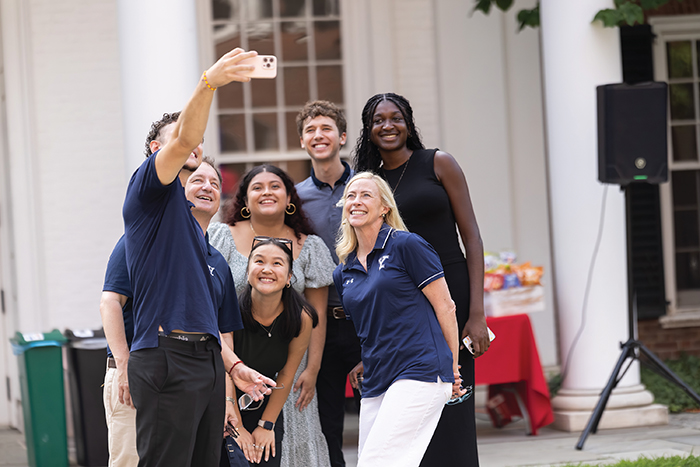
Above: The president on move-in day for the Class of 2029. The Yale Alumni Magazine publishes a short interview with President Maurie McInnis ’96PhD in every issue. In this conversation, McInnis discusses the challenges and opportunities students face in today’s changing job market with editor Pippa Jack.
View full image
Our grads are sought after, but the job market is rough and AI is rewriting whole categories of work. Are we past the point where a degree, even from a place like Yale, guarantees anything? A Yale degree guarantees what it has guaranteed for 325 years: that our students have the discipline of thinking necessary to pursue knowledge in any field or endeavor. I use the word discipline specifically because, as a historian, I’m going to take us back to the Yale Report of 1828, issued at another moment of scientific disruption in American society. It said the two great points to be gained in intellectual culture are the discipline and the furniture of the mind—in other words, expanding the mind’s power and storing it with knowledge. Discipline of mind is exactly what a liberal arts education is supposed to give us—the intellectual habits of knowing how to question, how to analyze, how to listen and learn from those who disagree with you, and how to sharpen your ability to come to conclusions. It is that discipline of the mind that, when I speak with CEOs and other business leaders, I am increasingly hearing them ask for. Because the furniture of the mind—the knowledge—now can come, in part, from a single prompt to an AI agent. The CEOs I speak to are saying, in shorthand, send us more philosophy majors.
Students interested in public service often have a less clear path than peers in finance, law, and consulting. How is Yale fostering their ambitions at a time when the public sector is shrinking? Yale is committed to offering all of our undergraduate students the opportunity to participate in public service. To give one example of such an opportunity, there is a fellowship program run through the university called the Yawkey Community Service Fellowship, and it gives Yale students a stipend so they can take on a service-oriented summer internship in New England. I think the numbers show that this kind of support works, because nearly half of Yale students end up working summer jobs and internships in the nonprofit, government, and creative sectors. And for their first job out of college, nearly a third of them go into nonprofit or government work.
We often talk about our civic commitment to New Haven. Is that starting to translate into jobs for graduates who want to stay? Absolutely. One way is working for Yale itself—we were the number one employer for the class of 2025. A lot of those came through the Woodbridge Fellowship, launched over two decades ago, which offers recent Yale graduates a full-time paid position in one of our offices around the university. We also have the President’s Public Service Fellowship, which connects Yale students with summer internships at a variety of nonprofits throughout New Haven. Since it began in 1994, more than 1,000 fellows have contributed over 400,000 hours of community service in New Haven.
The endowment tax, federal funding cuts, and a contracting job market are putting graduate students in a precarious position. You were a grad student once. What advice would you offer? I can identify with the uncertainty that many graduate students are feeling. Job markets are cyclical—certainly, when I was finishing my PhD, there were extraordinary predictions of a horrific job market. We now know that almost 50 percent of our PhD students are interested in pursuing a wide range of career options. It is important to understand the graduate degree as having perennial value: it teaches you a wide variety of skills that are about how to think, how to analyze, and how to communicate.
Alumni are an enormous asset that Yale is still figuring out how to maximize for career support. What would that take? Alumni are undoubtedly one of our greatest strengths, whether around this topic or so many others. We have over 190,000 living alumni. But of course, the expansiveness of that is also a challenge, because it can be hard for students to figure out where to start or how they can connect. One of the obvious ways to make these connections is through our nearly 300 alumni groups, many of which are focused on specific fields or career paths. Our alumni do so much to connect with our students: they serve as mentors, and they build these amazing alumni network communities. Through efforts like these, they open up opportunities both for current students and for other graduates. So I would say we need to double-down on what’s already working.
 loading


 Print
 Email