Michael Grecco
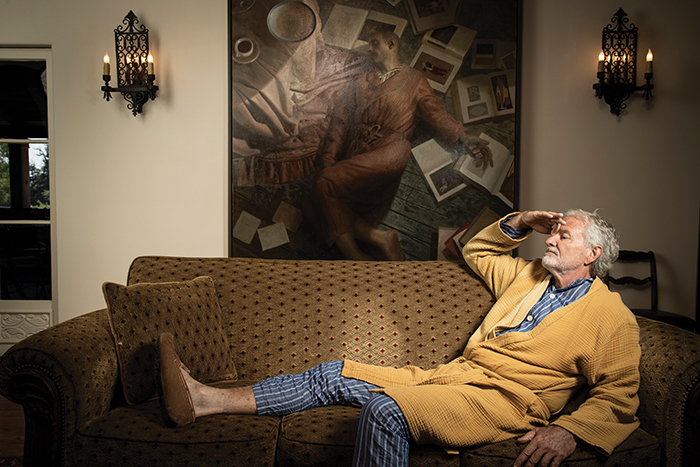
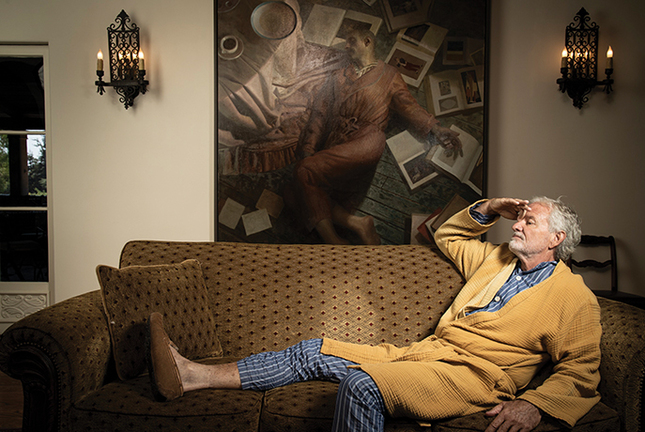
Christopher Lloyd ’82 beneath a painting by Vincent Desiderio in his Los Angeles home.
View full image

Michael Grecco
Christopher Lloyd ’82 beneath a painting by Vincent Desiderio in his Los Angeles home.
View full image
Courtesy Christopher Lloyd ’82
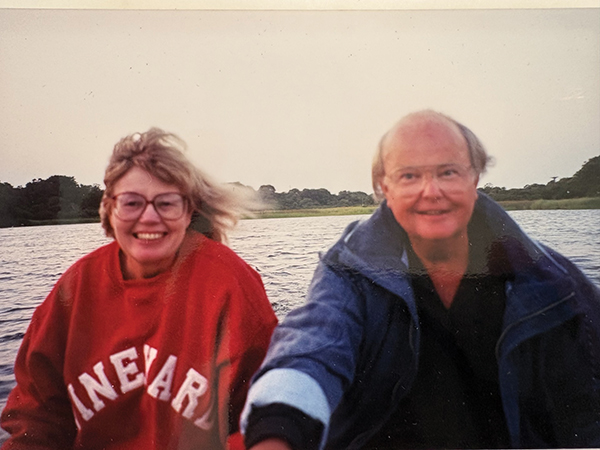
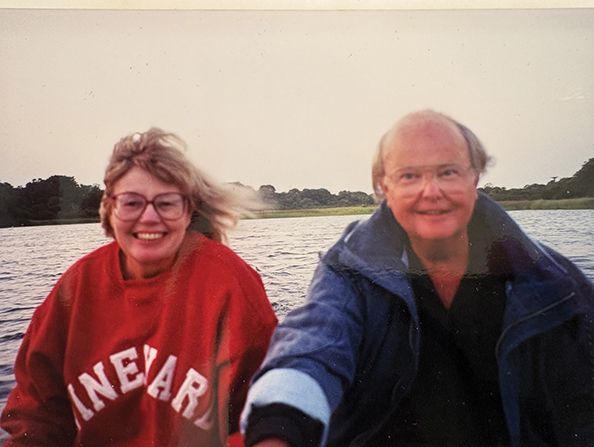
Christopher Lloyd’s parents, David Lloyd ’56 and Arline Lloyd, on their beloved Martha’s Vineyard in about 2001.
View full image

Courtesy Christopher Lloyd ’82
Christopher Lloyd’s parents, David Lloyd ’56 and Arline Lloyd, on their beloved Martha’s Vineyard in about 2001.
View full image
Courtesy Christopher Lloyd ’82
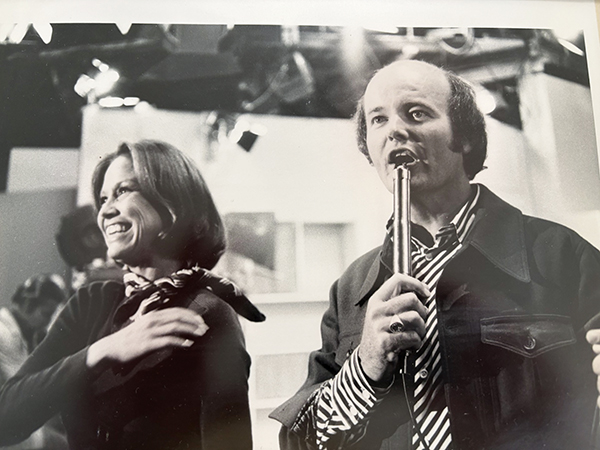
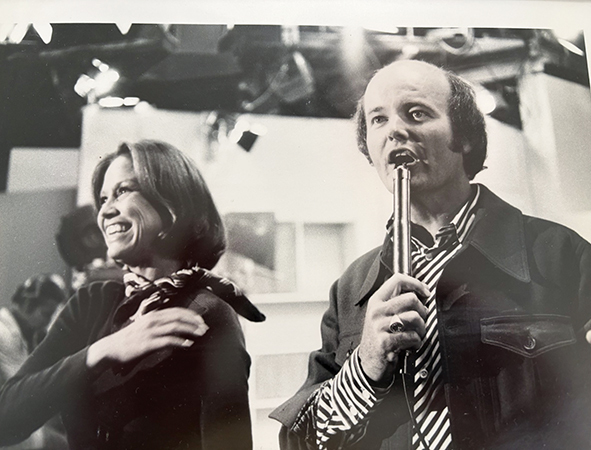
David Lloyd with Mary Tyler Moore on the set of her eponymous sitcom, circa 1976. The senior Lloyd wrote a Moore episode (“Chuckles Bites the Dust”) that TV Guide once declared the greatest television episode of all time.
View full image

Courtesy Christopher Lloyd ’82
David Lloyd with Mary Tyler Moore on the set of her eponymous sitcom, circa 1976. The senior Lloyd wrote a Moore episode (“Chuckles Bites the Dust”) that TV Guide once declared the greatest television episode of all time.
View full image
Courtesy Christopher Lloyd ’82
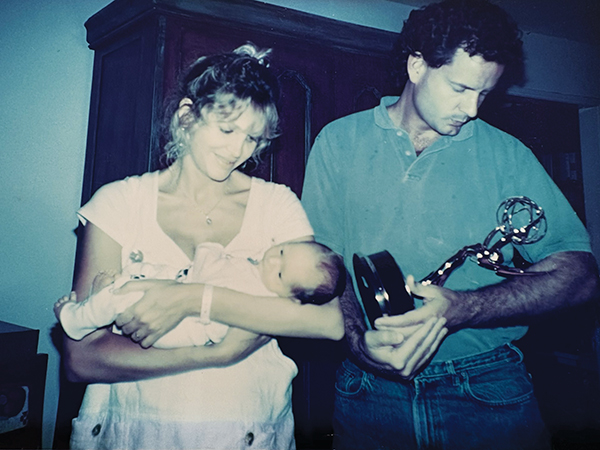
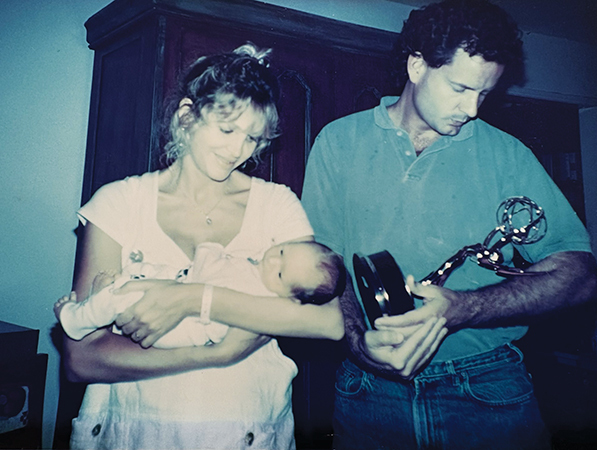
Lloyd and his wife Arleen Sorkin pose with their firstborn son Eli—-and Lloyd’s first Emmy—-in 1994. Sorkin, an actress, writer, and producer, died in 2023.
View full image

Courtesy Christopher Lloyd ’82
Lloyd and his wife Arleen Sorkin pose with their firstborn son Eli—-and Lloyd’s first Emmy—-in 1994. Sorkin, an actress, writer, and producer, died in 2023.
View full image
Michael Grecco
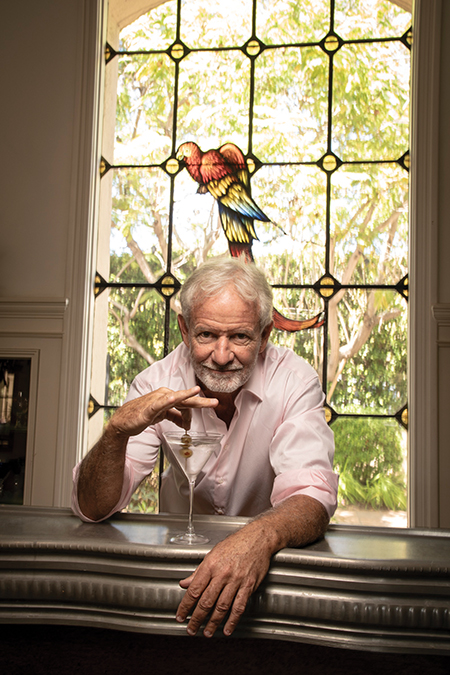
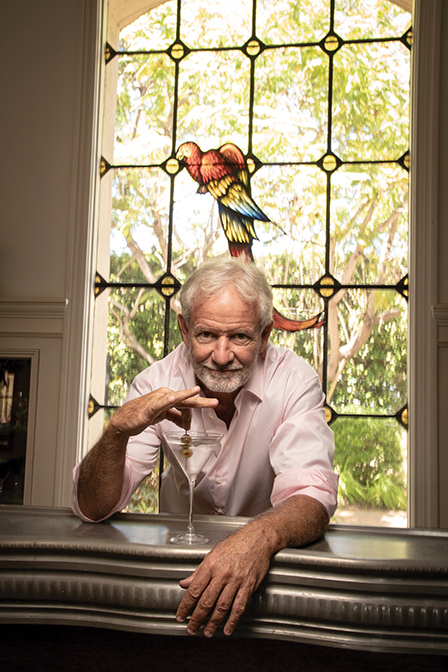
In addition to “getting to the truth of things,” Lloyd (shown here at his home bar) says he enjoyed his classes because they gave him a new store of facts that can “come in handy at a cocktail party.”
View full image

Michael Grecco
In addition to “getting to the truth of things,” Lloyd (shown here at his home bar) says he enjoyed his classes because they gave him a new store of facts that can “come in handy at a cocktail party.”
View full image
I was sitting in my car, thinking about sending some nude pictures of my wife to Denis Leary, when flashing police lights bloomed in my rearview mirror, and it seemed like a good time to review the steps that had brought me to this point.
Some time before, I’d turned 60, slid into the slippers of semi-retirement, and found that my once highly structured life had become a little rudderless. A contrast with my life of 20 years prior makes the point. I was then the showrunner of the television show Frasier, the nominal boss of some 150 people, charged with producing 24 episodes per year.
Life at home was no less rambunctious. I had an open-hearted wife who viewed a guest room in our home left unoccupied by a friend with a sad story as a crime reportable to The Hague. And there was the quarrelsome gay couple who lived down the hall. This couple was actually our two sons, 10 and 6, who, though they had separate rooms, chose to share a bed each night from which they staged back-to-back arguments steeped in high dudgeon. (“Does your breathing have to be SO loud?”/ “Don’t worry. Thanks to your freezing feet, my teeth will be chattering soon and drown out the breathing.”) These inevitably led to avowals never to share a bed again, but by morning I would find them intertwined like a caduceus.
I also had my parents living nearby: my sweet, breast-beating Catholic mother, a swallower of feelings and, relatedly, a chronic IBS sufferer, and my father (David Lloyd ’56), a bona fide legend in my industry with whom I’d had a fraught relationship my entire life, who also just happened to be one of my 150 employees.
So those days were marked with tight scheduling and great fulfillment. But now, 20 years later, I was working only intermittently, the gay couple had moved out, my father had died, my mom was ailing, and my wife was in the latter stages of a long bout with multiple sclerosis that had left her tended to by nurses, and had often left me looking on, feeling I should be doing something but unsure what. Unstructured, at times undone.
So I tried something. Yale had recorded several dozen of its most popular classes for public consumption, and I jumped into one. By the time I’d made it through Introduction to Ancient Greek History, I not only learned that in the Spartan wedding ceremony, the bride is seized by the groom’s friends, has her head shaved, is dressed in men’s clothes, and then is brought to a dark room to attend consummation. I learned that I enjoyed taking courses.
So I took 22 more.
I cannot claim to be a great student. But I do enjoy a factoid, if for no other reason than that it can come in handy at a cocktail party. We all know Marie and Jason. And we all know the dead-eyed look that comes over Marie’s face when the name Samuel L. Jackson comes up at a party because she knows what Jason is going to say before he says it. “Interesting fact about Samuel L. Jackson,” he says as her lips turn white, “he was actually an usher at Martin Luther King’s funeral.” And Marie imagines shaving Jason’s head and pushing him into a dark room. I did not want to be Jason, and in our sixties, who among us is immune?
So now I was brimming with new data.
From The Atmosphere, The Ocean, and Environmental Change, I learned of the Coriolis Force and why it prevents a hurricane from being able to cross the equator.
From Principles of Evolution, Ecology, and Behavior, I learned of a mite that lives in the ear of a certain moth. But only in one ear. Why? Because bats hunt these moths by letting out a screech which rebounds off the moth, giving away its location, and the moth, hearing the screech, takes evasive action. But only if it hears the screech. So evolution has taught the mite that, plush as a moth’s ear may be, if its other ear is already occupied, he needs to continue his apartment search elsewhere.
From Introduction to Theory of Literature, I learned that the towering philosopher Jacques Derrida was named after the child actor Jackie Coogan, whom his parents had seen in a Chaplin film, and who would, in adulthood, star in a popular television show, The Addams Family. That’s right, the grand pooh-bah of deconstruction, him before whom legions of hermeneutics scholars had genuflected, was named after Uncle Fester.
Yes, I enjoyed ramrodding these tidbits into the blunderbuss I would carry into cocktail party warfare. (“Interestingly,” I’d say to Marie, “the word ‘symposium’ actually comes from the Greek phrase ‘to converse while drinking,’” and she would beam and press her empty glass into Jason’s solar plexus, never once taking her eyes off of me.) But even more I enjoyed the feeling of being in a classroom again. At the end of each course, reliably, the professor would close the lecture by simply saying “thank you,” triggering applause, and just as reliably I would blink back a tear, because why on Earth were these sages thanking us when we should be thanking them? They were the ones tightening up our brains, making us more interesting people. Or maybe it was just that such people had been my surrogate parents once, and now they were again.
Somewhere during course 14, the Early Middle Ages, as I was learning about how violent King Chilperic had ducked a fight with the bishop Gregory of Tours on the flimsy pretense of urgently needing to add four letters to the alphabet, my mother died. It had been a long vigil for us five siblings, and I like to think a few of my newly harvested factoids were a welcome counterpoint to the grim metronome that was her oxygen machine: “Hey guys (WHOOSH) guess what doesn’t hibernate? (WHOOSH) Bears!”
Going through my mother’s things, we realized she’d never quite gone through my father’s. Thus I came to enter the reliquary that was his office, and an opportunity to go through his desk.
My father was a brilliant, funny, irascible man, far more at home in a room full of comedy writers than in a room full of family members. And we, his five children, often lived in fear of that talent for barbed put-downs he’d honed in those comedy precincts. I don’t think this was malevolence on his part, more an expression of his frustration that there were all these people—let’s call them children—sharing his home and his wife. So he bullied us into silence. If he ever wondered what responsibility he bore for the outsized number of bed-wetters, nail-biters, and stutterers he found at his dinner table, he didn’t show it. Nor did we. He welcomed discussion of emotion with the same level of hospitality Frankenstein’s monster showed to fire.
When I went through a serious bout of depression in college and clearly manifested it at the dinner table on a trip home, no mention of it was made. Heading to my room, I heard my father say to my mother, “Do you think it’s time to call our famous friend?” I immediately realized this was a suggestion that the problem of me be outsourced to their friend Dick Cavett [’58] who, I knew, had undergone electroshock therapy. Let’s not talk about the problem, let’s just strap on the metal helmet.
The gulf between us notwithstanding, I idolized my father and wanted to follow in his footsteps. But I utterly lacked confidence, and he hadn’t done much to engender any. Worse still, he was a little bit famous, a condition I traded on for social standing, even if this made him stand still taller and cast an even deeper shadow for me to live in.
Post-college, in my early twenties and living in New York, I was in the habit of typing letters home. Once I got off a particularly good one that ended with a bit of poetic flair, a description of painting my windowsill barefoot, while staring out at New York and dawning adulthood, as sunlight pooled at my feet. I mailed the letter and strode on sun-dappled feet back into my miserable life as an office temp. After three weeks passed with no response, I was having lunch with my sister Julie [’81], and she casually stated the following: “Oh, Dad read your letter, and he said to Mom ‘now I know Chris will be a writer.’” It sent a jolt through me. Remembering it today, it still does. What seems plainly bizarre—but which seemed utterly unsurprising at the time—is how this vote of confidence actually reached me. My father gave it to my mother, who conveyed it to my sister who, three weeks later, passed it on to me. An arabesque of indirect communication, even for our repressed household.
That small victory, glorious though it was, did not slake my thirst for acknowledgment. Sometimes we follow in people’s footsteps just so we can catch them by the collar and spin them around. My father had won two Emmy awards in the 1970s, and in 1994 I was up for one myself. The nervous night came, and I found myself in a group of joyous colleagues when Frasier was named best comedy of the year. On my mind was only one thought: I’m halfway there. Two years later we won a third Emmy. If I felt any Oedipal guilt over running my father through with the pointy tips of that award, I needn’t have worried. A few months later, TV Guide published its list of the 100 greatest television episodes of all time, and a script my father had written made the list. At number one.
By that time, I was in my fourth year as my father’s boss on a show that was, at least in part, about the fractious relationship between a father and son. But we kept our own fractiousness to a minimum. It can’t have been easy for him, working for his son. I know I found it confusing, even embarrassing, to be openly vying for the approval of an underling who happened to be my father. Once the staff was writing a scene where Frasier’s live-in caretaker Daphne is discussing her ill-behaved parents and brothers. She’s ashamed of them, but feels guilty about this, and wants to express all this to Frasier. And we needed to write a line for her. After a brief silence, I pitched this line to the room: “What is it about family that it can be so hard to like them, and impossible not to love them?” And I looked to my right, to my father, and he nodded, and the line went in the script. It was years before I realized how layered that moment was: me, drawing on my own painful experience with my father, trying to come up with a line to convey that feeling of helplessness, and then looking to my father to validate it. And then carrying on like business as usual which, champion repressers that we were, we did.
So there I was, now fully orphaned and in my 60s, sifting through my father’s desk. There was poignant memorabilia from the many decades of his career—the Cheers years, the Mary Tyler Moore period, that notorious TV Guide—and on back to a program from a college play he’d acted in with the electrifying, but not yet electrified, Dick Cavett. There was also a letter from his own father, written to him when he was in his twenties. His father, himself a writer, knew my father had an idea he might try to be an actor. Gently, encouragingly, his father told him he was good with words, and was funny, and he thought my Dad had the makings of a good writer. My Dad kept that letter for 50 years. Nearby, I found another letter. It was my own letter home from sun-dappled New York. The man knew that sons like their fathers’ validation—he’d kept his father’s letter his whole life. Nonetheless, he’d kept mine too, for 28 years, never saying a word.
My wife was frail by this point, but the courses I took over the next 18 months gave me many occasions to reflect on our fanciful journey together. In Introduction to Classical Music, I learned of Hector Berlioz, a young composer who fell in love with an actress he saw onstage and composed a symphony about her, his famous Symphonie Fantastique. She was so moved she jumped into marriage with him . . . followed by 21 years of bickering and misery. He found operatic ways of calling her fat. Likewise, I had met Arleen when she was a young actress. Would I ever forget the startling moment early in our acquaintance when, in a foreshadowing of her legendary charitability, she asked if I wanted to take a bath with her?
Words, as we know from Jacques “Uncle Fester” Derrida, are often defined by their limitations; “yes,” in this moment, was nowhere near yes enough to convey just how yes I wanted to take that bath. Arleen was no Harriet Berlioz.
Arleen’s benevolence could also be infuriating. More than once I learned our house was hosting a charity event only when I pulled into my driveway and was greeted by a valet handing me a ticket. But when that generous spirit shone my way, I felt as many of the snake-bitten patients of Andromachus the Elder must have felt after being fed viper meat, one of history’s first known antidotes. (Thank you, Epidemics in Western Society since 1600.) Arleen was in many ways an antidote to my father, a source of joy and support, a builder, not a shaker, of confidence. Palpably, in our own symphonie fantastique of a life together, I felt his shadow over me retreat. But now there was a new shadow, a lengthening one, that of her illness.
And it was hard to blunt the unique pain of knowing that the person who had in so many ways provided me a cure was herself victim of an incurable disease.
Finally, her disease became too much. Yes, there’d been time for me to prepare, but is there ever proper preparation for the loss of a spouse who is such a life force? Had she ever crossed the equator, I’m confident the Coriolis Force would have backed down.
We all need a witness in life, Arleen had been fond of saying. And I lost mine. Hadn’t she been the first person I’d gone to with an anecdote from a course? (“So Charlemagne was 6' 7 " but his father was named Pepin the Short. Scholars now believe his Dad was just as tall as Charlemagne, and this may have been one of the earliest historical incidences of sarcasm!”) Surely a low point in my grieving was when I realized that Arleen was the person I’d had more conversations with than anyone, and I’d have no more.
Well, maybe one more.
As I had two years earlier with my father, I had made my way to her desk. And there, among old press clippings and crayon-drawn Valentine’s cards, I found a manila envelope with 18 nude photos of her, from a time before I knew her. Beautiful, sexy photos. What, exactly, do you want me to do with these, I asked her.
What do you think, she replied rabbinically.
I didn’t know. It felt strange to keep them, but somehow an affront to her not to. So, I put them in my drawer, then dimly recalled that I myself might die some day and was it going to solve whatever pain my boys would feel about my passing to run across a Polaroid of their mother perched on top of a Las Vegas room service cart?
The Polaroids wound up in a gym bag, secreted in my car, and I found myself asking a second question: Why had she kept them all these years? Had she had a premonition of how her body would one day turn on her and wanted a record of herself at her best? Were they meant for me—as a remembrance of happier times or even, awfully, an apology? I’m so sorry this all went away, but it was like this once, remember?
I started to feel an impulse to do something with the photos, something somehow positive. Wasn’t she always looking to enhance people’s lives? Which is how I came to be in my car remembering that Denis Leary had coveted her when they were in a play together in college. Was it absolute madness to consider . . . that thought quickly gave way as red lights filled my rearview mirror and I began to imagine just how I was going to explain to the policeman why I had a compendium of nude shots of a woman forty years my junior. The cop was actually after the guy in front of me, but I took it as a sign I should be leery of sending the pictures to anyone.
I still have the pictures. I look at them on occasion and they make me feel different things every time. Will those Polaroids traumatize my kids one day? I guess it’s a question now of whose color fades first, mine or theirs.
Those 23 courses I took were welcome company during a time I experienced profound loss, in no small part because they reminded me how life-affirming learning can be—getting to the truth of things, discovering what actually happened, what actually is.
So I felt a twinge of anti-historical guilt when I found myself examining the contents of my own desk drawer, wondering what picture of me it might paint, and what items I might consider removing. Are we allowed to curate how we are remembered? Why, I wonder, don’t old people make their last tennis ball-steadied walker journey straight to their desks to gather all diaries, love notes, and bearskin-rug portraits and send them off in one glorious bonfire?
Maybe it’s because, like my Dad, they want us to find those things. Maybe these items say things these people never could. Maybe what people want, finally, is to be seen. Maybe it’s all they’ve ever wanted.
 loading


 Print
Print Email
Email