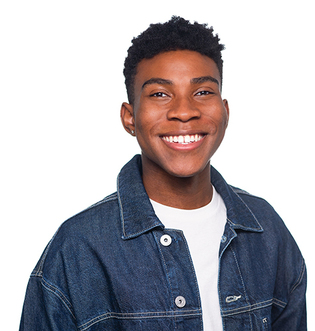
Courtesy Kahlil Greene
Kahlil Greene ’21 is a TikTok and Substack star who calls himself the “Gen Z Historian” (Gen Z is the generation born from 1997 to 2012.) A former president of the Yale College Council, Greene says his career path shifted unexpectedly after graduation
View full image
When Kahlil Greene ’21 was elected as Yale’s first-ever Black student body president in the spring of 2019, he remembers feeling “motivation” rather than pressure. He could never have predicted that a global pandemic would force him to challenge university policy from a Maryland quarantine. “It was surreal, an insane commitment,” says Greene, recalling those hectic months. “I would wake up at maybe 6 a.m. and go to sleep at 1 a.m. every single day, working on Yale College Council stuff.”
Greene’s “crowning achievement,” he says, was pressuring the school to shift from grading to a universal pass-fail policy for the spring 2020 semester, when students switched to remote learning. He also poured his time into the school’s racial justice movements after the murder of George Floyd. When some of his related internet content went viral, Greene discovered a career path that he still finds unlikely. Today, 26, he’s a TikTok and Substack star who calls himself the “Gen Z Historian.” He’s won a Peabody Award, twice been nominated for Emmys, and last year made Forbes’s 30 Under 30 social media list. Greene spoke with Eric Olson ’11 about his time at Yale and his career.
Eric Olson: How do you look back on the #NoFailYale movement now, six years after it happened? Are you surprised that you actually succeeded in getting the school to shift policy?
Kahlil Greene: The amount of effort that it took to change the minds of students and administrators, and then having the policy go through, it was an impossible thing. One of the early policies that was more accepted by administrators and students was the idea of grades being optional, so some students would have them, some wouldn’t. But what we were pushing for was a universal pass-fail. It was just for the spring [2020] semester. At the end of the day, we did a giant referendum, and the referendum overwhelmingly passed.
EO: Your first viral TikTok video, in 2021, involved the whitewashing of Martin Luther King Jr. quotes. What was your relationship with social media and how did it change after that?
KG: I had moments of virality before then, of being popular on social media, but nothing that was not tied to a specific moment.
When I made that first video, sort of on a whim, I was taking time off after Covid and after being YCC president. I needed to get away from Yale for a bit. In terms of a sustainable platform to build a career off of, it’s impossible to overstate just how popular TikTok had become in 2020. Every single person was on it. All the trends were there. All the commentary and discourse was happening there. The election was occurring through TikTok. So it was the most natural place to go to as a Gen Zer that lived through the pandemic.
EO: How did you come up with the “Gen Z Historian” name? What inspired you to take a history slant?
KG: Everyone who is on social media has an alias, a branded name for people to remember you. Gen Z was a big buzzword at the time because everyone was wondering how Gen Z was affected by the pandemic, how we were going to go into the workforce, and what was going on with our culture.
Especially after the murder of George Floyd, and the tearing down of monuments and statues, history was top of mind for people. I was a history major in college, and a lot of the history that I studied was not generally known. I think the more information you have, as long as you have a normal sense of values, when you learn about what happened to Indigenous people, or Black people, or populations around the world at the hands of the United States government, it’s shocking. I thought if I could expose that through digestible videos, people would benefit from it and be entertained by it. That was the mindset that I had going in.
EO: How do you pick topics? What’s the proper balance of entertainment and intellectual rigor?
KG: The nice thing about social media, also a bittersweet thing about social media, is that you can’t plan too far in advance when curating a topic to talk about. That’s a sort of skill set, being a cultural sponge, where you just have to absorb what people are talking about, what’s trending online, what political breaking news is happening, and absorb it all and then come up with your unique angle or take. There are perennial history lessons that I might dig into, but my best videos are pretty spontaneous. Still, while the hook is spontaneous, the backbone is based off of knowledge that I’ve already researched or knowledge I already have.
EO: And how do you research? Where do you research?
KG: I watch a lot of YouTube. I read a lot of books. Right now I’m reading A Resistance History of the United States [by Tad Stoermer] and The Rediscovery of America, which is by a Yale professor [Ned Blackhawk]. I wasn’t in his class, but I can always call him up and ask him something.
EO: You’re on social media a lot. What are your thoughts on the politicization of that technology, and the overall direction of the internet?
KG: I’m optimistic about it. A lot of people see things like AI, general downward trends in the economy, and global wars, and they feel quite hopeless about the future. But I think about my future, in five to ten years, and I’m optimistic about where social media has taken me and will take me. When Trump first got into office, there was a pullback from companies, organizations, and even platforms promoting or supporting progressive content. But it lit a fire under me to diversify my income. That’s when I started my Substack.
I still really love the work of content creation. This week I’m trying to put out my first full-length YouTube video, high-quality, fully edited. That’s exciting for me, because it’s a whole new genre. I’m also working on a book called Hidden History.
EO: If someone had told you about this career path, say, when you were YCC president, would it have surprised you?
KG: Oh, it’s surprising. I had a job offer from McKinsey & Company. I had my start date and everything. And then I first went viral. They have a policy where, if you go to grad school or do a different job for a short time, you can postpone your start date. I asked them if I could do that for content creation. They said no. [Laughs] Perhaps expected, I don’t know. At that point, I had not necessarily built enough of a following or infrastructure around my content to guarantee success and a full-time career. But I had faith in myself, so I just went full speed ahead.
It wasn’t until the first few viral videos that I thought this could be a thing, because it wasn’t a thing. It wasn’t a career. I guess there were some YouTubers, but they were so few and far between that it didn’t seem attainable. The idea of influencer as a career path is quite new, and it was nearly nonexistent then, especially for the history space.
 loading


 Print
Print Email
Email