Yale University Art Gallery
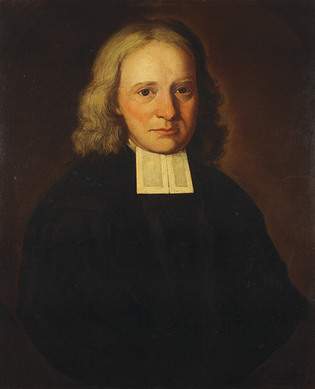
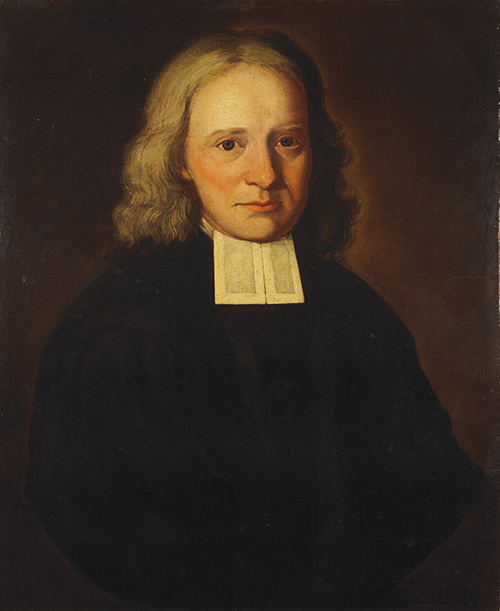
The Yale Art Gallery’s portrait of the Reverend James Pierpont was painted in 1711, three years before his death, by an artist known today only as the Pierpont Limner.
View full image
James Pierpont was the single greatest founder of the Collegiate School—what we now know as Yale University—325 years ago this October. Pierpont (1659–1714) is also among the founders least recalled in buildings and memory: Consider the tributes afforded to other people connected to the university’s origins such as John Davenport, Abraham Pierson, Timothy Woodbridge, or Elihu Yale.
Graduated from Harvard College in 1681, Pierpont had first come to New Haven from Massachusetts in 1684, called to serve as pastor of the town’s founding church, now known as Center Church on the Green. He was ordained as a Congregationalist minister on July 2, 1685, and would serve as pastor of the church until his death on November 22, 1714.
Pierpont was the third person called to lead the church, which was central to New Haven’s life at the time. He had close ties to the legacy of John Davenport (1597–1670), the cofounder of New Haven and founding pastor of the church, who served from 1639 to 1668. Davenport was the first person to conceive of a college for this new area of English settlement, an idea that would eventually be founded by Pierpont and a set of other ministers in Connecticut. Pierpont was not only Davenport’s heir as church pastor, but he also had ties to his family, first boarding with Davenport’s daughter-in-law and then marrying Davenport’s granddaughter, Abigail, as his first wife.
In 1689, Pierpont purchased, for 40 pounds of rye and 32 bushels of corn (worth about 12 pounds, 18 shillings at the time) a set of books that Davenport had first collected in 1656 for a college, with the assistance of Theophilus Eaton, cofounder of the New Haven colony. These were the core of the books that would be accumulated for what continues today as Yale’s library. George Wilson Pierson ’26, ’33PhD, in his 1988 book The Founding of Yale, writes of Pierpont’s purchase, “At that moment, if not sooner, must have become fixed the firm determination to revive and realize John Davenport’s dream.”
That dream was finally realized in October 1701, when the General Court of Connecticut first met in New Haven, then the co-capital with Hartford, and adopted “An Act for Liberty to Erect a Collegiate School,” giving the school its charter and creating what would go on to become Yale University. Pierpont took the lead in getting that charter, and he would serve as a trustee until his death in 1714.
Pierpont also was very close to John Dixwell, one of the three regicides of Charles I who had fled to America after the Stuart Restoration in 1660. Dixwell settled in New Haven, living under the name James Davids, and eventually was made a member of the church by Pierpont. His son, also named John Dixwell, went to England in 1710, tasked by Pierpont with an important piece of business concerning the young collegiate school: to contact Jeremiah Dummer, who would serve as the agent for Connecticut in London.
Dummer assembled a collection of more than 700 books that would be sent over to the new young Connecticut college, making its library all the more robust. Dummer’s efforts were also essential in securing the donations of Elihu Yale himself, great enough that the place eventually took on his name.
Leonard Bacon, Class of 1820, who succeeded Davenport and Pierpont as pastor of New Haven’s founding church, wrote in 1839 of his predecessor’s work with Dummer a century earlier: “The activity of Mr. Pierpont, as one of the original trustees of Yale College, is evident not only from the early records of the institution, but also from letters written to him by the agent for the colony in London, whose good offices he had secured in aid of that favorite undertaking.”
That undertaking, with Pierpont as chief founder, has grown enormously over 325 years. Memory of his life and service has not grown proportionally.
In recent years there has been some new work on Pierpont, including acknowledgement that he and his brothers enslaved people. Craig Steven Wilder, in the 2013 book Ebony and Ivy, notes that the Pierponts enslaved two Black men, listed as Tom and Pung, and that they also owned a plantation and enslaved people in South Carolina. There remains more to know about Pierpont and his legacy.
In his 1974 book Yale: A History, Brooks Mather Kelley ’53 has a footnote that merits notice still: “It is unfortunate that Yale has never seen fit to create a distinguished memorial to James Pierpont, the founder of Yale. One might, in fact, even call him its progenitor.”
 loading


 2 comments
 Print
Print Email
Email
2 comments
Fascinating to learn how central James Pierpont was to Yale’s founding and how much of his story has faded from institutional memory. Really enjoyed this piece.
P.S. I’m reminded of Judith Ann Schiff’s 2004 Yale Alumni Magazine piece, “Yale’s First Student,” which described James Pierpont as “the principal founder of Yale.” Wonderful to see his story brought back to the forefront.
http://archives.yalealumnimagazine.com/issues/2004_05/old_yale.html