Mark Alden Branch ’86
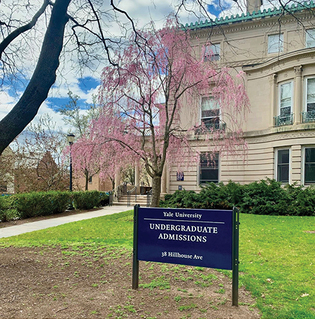
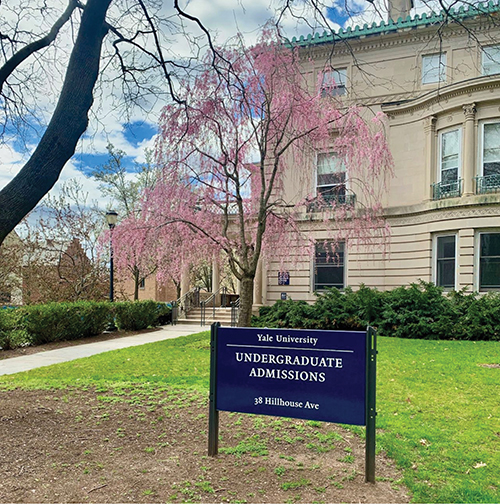
The undergraduate admissons office is being investigated by the US justice department, along with the admissions offices of the School of Medicine and the Law School.
View full image
Anyone expecting a quiet summer at Yale got a surprise on June 26, when the New York Times broke the news that the university was in discussions with the US Department of Justice over a federal investigation of the university’s admissions practices.
The story began in May, when the department issued a letter accusing the School of Medicine of using “racial proxies” to favor Black and Hispanic applicants, in violation of the Supreme Court’s 2023 decision prohibiting the consideration of race in admissions. At the time, spokesperson Karen Peart said the university was reviewing the letter and that it was “confident in the rigorous admissions process” at the medical school.
Six weeks later, the Times reported that the investigation also included admissions practices in Yale College and the Law School, and that the university was negotiating a settlement with the justice department. In a July 13 statement, President Maurie McInnis ’96PhD confirmed the scope of the investigation and acknowledged that Yale was in talks. “It is a standard and important practice that lawyers for the involved parties and the government participate in conversation and exchange of information to determine whether they can resolve the matter without further legal action,” she wrote. “It is a required and reasonable step, and we are participating in good faith.” An informational page has since gone up: president.yale.edu/department-of-justice-investigations.
Calls for Yale to resist a settlement came swiftly: from an alumni group called Stand Up for Yale, whose open letter had more than 5,400 signatures as of early August; from the American Association of University Professors and the American Federation of Teachers, which sent an open letter to McInnis and the Board of Trustees; and from eight Yale-connected Connecticut lawmakers, who warned that a settlement “could jeopardize Yale’s relationship with the State of Connecticut—including state-granted privileges the University has long taken for granted.”
The argument of those opposed to settlement has two main components. First, they say the government’s case on the question of admissions discrimination is legally weak, based on the evidence cited in the May letter from the justice department. In a Bloomberg Law op-ed, Law School professor Issa Kohler-Hausmann ’08JD argued that the Trump administration is asserting that the Supreme Court’s decision “banned every consideration of race. That’s false. [The decision] distinguished categorical racial preferences, which it banned, from contextual uses of race, which it allowed—without clearly explaining how to tell the two apart.” By settling, she argues, Yale would “help create a constitutional rule—without the public judicial reasoning that constitutional adjudication demands.”
Second, settlement opponents argue that the Trump administration cannot be trusted to stick to a deal. “There is no evidence that any university has settled its way to lasting security,” the Connecticut legislators wrote in their letter to McInnis and the trustees. “There is considerable evidence that settlement simply invites the next round of demands.”
In her July statement, McInnis laid out five “fundamental principles” in the university’s approach. “First, we are wholeheartedly committed to safeguarding academic freedom. Our students and faculty have the intellectual freedom to study, teach, and publish according to their scholarly interests in keeping with the standards of their discipline. Second, Yale must maintain the right to decide who we admit and hire in accordance with the law. Third, we hold dear our university’s tradition of protecting free expression on our campus. Fourth, we are determined to continue advancing Yale’s mission of education, research, and scholarship. And fifth, we make all our decisions by prioritizing our responsibilities to our students, faculty, staff, and patients, as well as the university as a whole.”
McInnis also asked the Yale community for feedback and thanked those who had already been in touch. “I very much want to hear those views and welcome your reply to this message,” she wrote.
There was no word on the fate of the case by the time of our press date in early August.
 loading


 Print
Print Email
Email