Dan Renzetti
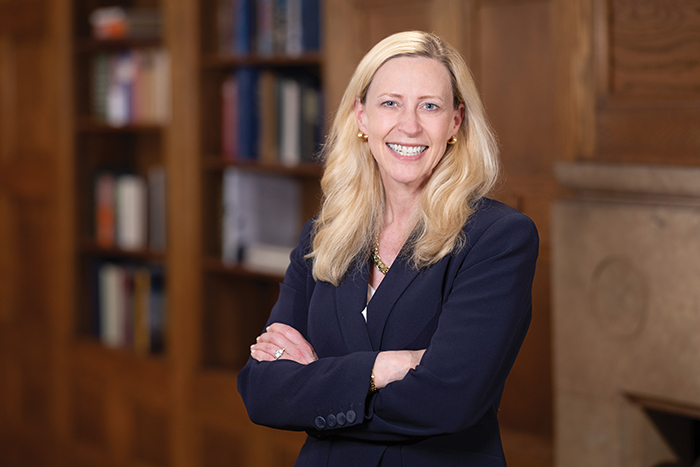
The Yale Alumni Magazine publishes a short interview with President Maurie McInnis ’96PhD in every issue. In this one, the president discusses the April report from Yale’s Committee on Trust in Higher Education with editor Pippa Jack.
View full image
You accept the Committee on Trust in Higher Education’s judgement that Yale has played a role in eroding public trust. Which problems are most acute here?
The decline in public trust in institutions of higher education is part of a larger trend of declining trust in all institutions. And yet, over the last decade, there is no institution that has had a more precipitous decline than higher ed. And of universities, people trust the Ivy League the least.
Why? Well, the single biggest driver of public skepticism is affordability. We can track confidence falling as costs have risen. Yale has very generous financial aid, and we recently announced free tuition for students with an annual family income of $200,000. But many families do not know this financial aid exists, so they don’t even apply.
Another aspect of this problem is that much of student debt in America is not from undergraduate education, but professional study. And there are fields where students carry higher debt burdens relative to their expected earnings; for us, that includes the Schools of Nursing, Public Health, and the Environment. So we still have work to do.
Another issue: access. We do not accept the vast majority of applicants. So right off the bat: too expensive, and too exclusive.
And this is all compounded by a broad sense that universities do not welcome the debate and dialogue that should be at the heart of an education.
To that point: Does the Woodward Report still have a role for Yale now?
The Woodward Report plays a foundational role for Yale in its defense of open inquiry. Education and scholarship depend on intellectual risk taking and a willingness to risk disagreeing.
I am wholeheartedly behind Provost Scott Strobel’s formation of a faculty committee to establish enduring principles of academic freedom. The report is expected at the end of the fall semester.
The trust committee also recommended self-studies on the breadth of scholarly methodologies and approaches across the university. I’m going to be working with the deans and academic leadership to put that in play as the fall semester begins.
And the committee recommended that we affirm the university’s mission statement as it was expressed in the Woodward Report, and as it has long been written in the Faculty Handbook. I’ve accepted that recommendation. At the same time, Yale pursues its mission through the Faculty of Arts and Sciences, Yale College, and our graduate and professional schools, which each make their own unique contributions.
What reforms will Yale pursue in other areas the public most questions: fairness in admissions, administrative bureaucracies, and research credibility?
Definitely all priority areas. Last fall I formed the Presidential Council on Yale College Admissions. When I received the trust committee’s recommendations related to admissions, I shared them with the presidential council and asked them to take those recommendations into consideration.
On bureaucracy and administration, at the heart of that is how we allocate our resources. That relates to external trust—if tuition costs are high, is that money being well spent?—but also internal trust. We want to be certain our resources are being dedicated to our mission with precision. I’ve asked senior vice president Geoff Chatas to create a faculty committee to support him in minimizing bureaucratic hurdles—to find savings, and direct that money toward our teaching, research, and scholarship.
On research credibility: our faculty are doing work that impacts the lives of thousands, if not millions, yet that’s not always understood by a larger public. So we’ve launched a new 50-state project to highlight the way Yale is touching communities in every state.
Grade inflation, device use, and loneliness are all problems on today’s campus. What steps might Yale take?
We really are at an inflection point in higher education. Cell phones, social media, artificial intelligence—they provide enormous opportunities, but they can drive people apart. Two impacts we see are isolation and distraction. For deep learning to happen, we have to provide classrooms that allow students to truly focus. The trust committee identified these as urgent issues.
We’re taking the recommendations and figuring out how to operationalize them. I asked vice president for university life Kimberly Goff-Crews ’83, ’86JD, to create a committee of students across our schools to help develop social media guidelines, and also to brainstorm new ideas for how we encourage more in-person engagement. One antidote to loneliness is community, yet it’s still a muscle you have to build. We want students to help lead the way.
There’s also the question of what role devices should play in the classroom. I’ve asked the deans to work with faculty and students to develop appropriate policies.
Regarding grade inflation, I’ve asked the Committee on Teaching, Learning and Advising to confront this issue within Yale College. We need people to trust the integrity of our assessments.
As we go forward, we will continue collecting feedback from the Yale community. This is ongoing work.
 loading


 Print
Print Email
Email