Allie Barton
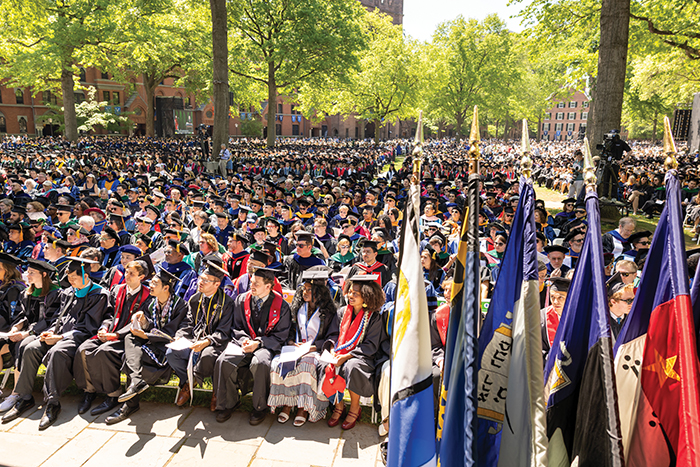
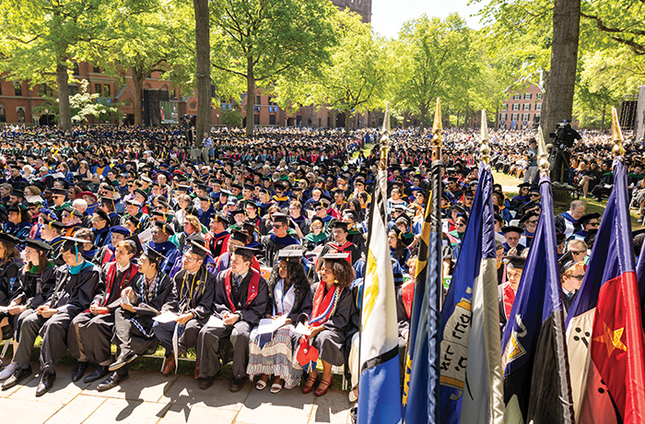
More than 20,000 well-wishers joined graduating students on Old Campus to celebrate Yale's 325th commencement.
View full image

Allie Barton
More than 20,000 well-wishers joined graduating students on Old Campus to celebrate Yale's 325th commencement.
View full image
Allie Barton
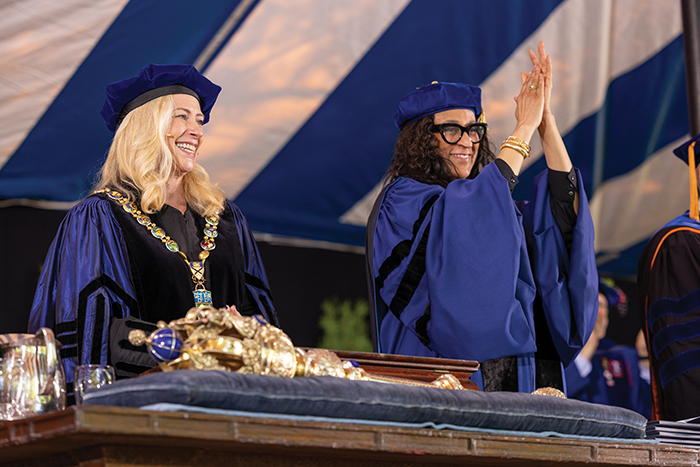
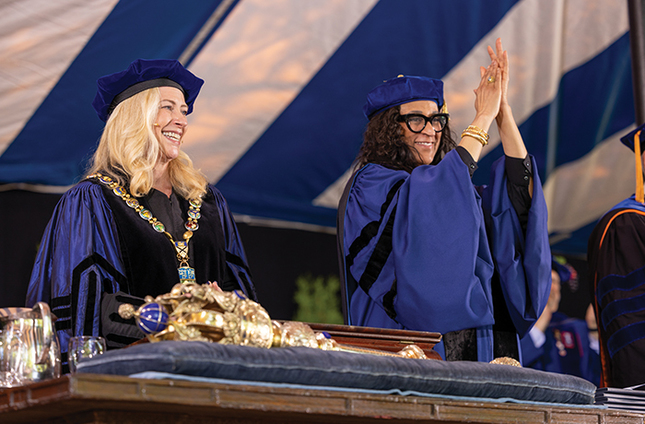
During commencement, President McInnis stands alongside Kimberly Goff-Crews ’83, ’86JD, vice president of university life and secretary of the university.
View full image

Allie Barton
During commencement, President McInnis stands alongside Kimberly Goff-Crews ’83, ’86JD, vice president of university life and secretary of the university.
View full image
Four thousand one hundred and forty degrees were conferred as Yale University celebrated its 325th commencement on May 18, a beautiful spring day. President Maurie McInnis ’96PhD tipped her hat to representatives of each of Yale’s schools in turn, students cheered, and Old Campus was bursting with the estimated 20,000 well-wishers in attendance: graduates—including Yale’s eight new honorary degree holders—families, and friends.
Around 400 Yale union members, currently in contract negotiations, protested outside Phelps Gate during commencement. A few political protesters inside Old Campus raised signs during the ceremony; they took them down when asked by university officials.
A day earlier the Class Day speaker, novelist Min Jin Lee ’90, spoke to the undergraduates—on the cusp of their new lives and bedecked in the now-traditional silly hats—about her own post-college trajectory. Lee stressed how the ideas planted at Yale led to a career path she hadn’t expected to follow. She practiced law before deciding to try writing fiction. As President McInnis told the Class of 2026 in her baccalaureate address, “You can’t know right now how some minor or grand story from Yale, how some concept you encountered in a class, how some remembered agreement or disagreement, will influence the decisions you’ll make, and the work you’ll do, that will change your life, and the lives of others.” The text of the address follows below.
__________________________________________
Graduates of the Class of 2026, faculty and family members, colleagues and friends: Welcome!
This is a day that’s poised between memory and possibility, between all that’s brought you here and all that you’ll bring to the world from here on out. It’s the kind of day that comes around only a few times in our lives—which also makes it the kind of day that provokes what’s called, in art historical terms, a collage of emotions. But there’s one feeling that can transcend all these other feelings.
Gratitude.
Let’s begin this morning, then, with some mutual appreciation. Friends and families, will you rise and cheer for the Class of 2026?
And now, Class of 2026, will you get up and applaud for the people who helped get you here?
Graduates, this is a memorable day at the end of some very memorable years.
Memorable because of you. You researched quantum error correction and bioinformatics and paleobotany and Mesoamerican pseudo-glyphs. You staged A Midsummer Night’s Dream, Fiddler on the Roof, and Intimate Apparel by the extraordinary Lynn Nottage ’89MFA, alongside productions that you wrote yourself about Friedrich Nietzsche and a beauty salon. To be clear, those are two different productions.
You started businesses to create health technology and musical technology and, yes, technology to manage all our other technology. And you lost your voices cheering our football team on to victory in The Game four years in a row. The last graduates who could brag about that were in the Class of 1908.
I’m sure you can recall these events with precision, because they’re some of the defining events in your class’s history, and they’re the material with which you’ve already begun forming a community of memory. But I promise you this: The way you remember your college years, and the way you remember yourselves and each other, is going to change. Because you can’t anticipate right now how both these glorious events that I’ve just enumerated—and your perhaps more forgettable undertakings—will assume new meaning in some future moment; how those memories might determine the decisions you’ll make at all the unexpected junctures of your personal history, and of world history.
Fred Smith ’66 and a mediocre paper
Some famous alumni have found surprising guidance in their memories. One took a mediocre essay he wrote for an economics class, and turned its thesis into the largest express transportation company in the world.(1) Another took what he had learned writing what he later deemed “banal and imitative” poetry for the Yale Literary Magazine, and became the first American to win the Nobel Prize in Literature.(2)
Their memories of Yale launched them into accomplishments they couldn’t have predicted at their own graduations. So, graduates, this morning has brought you to the threshold of this question: How will you use your memories of Yale to shape the future?
That’s a lifelong question that will require lifelong answers.
For now, I can offer you a clue I recall from my own studies here. When I was a graduate student, I read a book that would become something of a load-bearing wall in my scholarship. It’s called On Collective Memory.(3) It was written by a French sociologist named Maurice Halbwachs, who posited that memory is subjective; that your memories are formed by your relationships, and your relationships are formed by your memories. Your memories, like your emotions today, are a collage.
A collage of bright and disparate and sometimes even clashing recollections, glued together by your interactions with each other, and the stories you tell and the stories you hear from each other. When you come together, with your closest friends or your entire graduating class, these stories have a way of combining and overlapping and becoming your own. This act you’re participating in is the work of collective memory. It’s this shared remembrance that binds you together as the Class of 2026, and that binds you to Yale, and connects you with all the graduates who’ve come before you.
Generations tied by a common thread
Tomorrow will be Yale’s 325th commencement ceremony. Three hundred and twenty-four classes have preceded you. Like many of you, many of them spent their first night at Yale here on Old Campus, got inducted into not-very-secret secret societies, and were serenaded regularly by the nation’s finest a cappella singers. Though they may have lived in times that diverge from our own, their memories of Yale still converge with yours.
Professor Halbwachs would suggest that you can start to answer the question of your own memory by considering how your predecessors collaborated to answer that question themselves. One such answer is sitting cross-legged behind you: our statue of Theodore Dwight Woolsey. This memorial to our tenth president is reaching an anniversary of its own this year, since it was placed there on Class Day, 130 years ago, as a gift from alumni. And it exemplifies how, decades after students had graduated from Yale, they came to understand ever more fully the meaning of their time here.
You probably know President Woolsey best for his famed shiny toe. Some of you have no doubt rubbed his foot for good luck, as part of a ritual that you might’ve been told about on your very first tour of campus. It’s based on a story about how, at regattas, he would kick the Yale boat off the dock, which invariably led to victory.
That story, however, is completely apocryphal.(4) It originated probably in just the last thirty years, although it’s so fun we keep repeating it. But before President Woolsey became one of our fondest symbols on Old Campus, he was an ordained minister, an authority on international law, an expounder of Aeschylus, and the leader of Yale for 25 years. Even while he served as president, he continued to teach political economy to seniors. After he died, his cousin Timothy Dwight V, who was also the president of Yale at the time, memorialized President Woolsey with these words: “He lived as truly in the inmost lives of his pupils.”(5)
So it was that, almost seven years after President Woolsey’s death, his former students determined to preserve their memories of his imposing scholarship and abundant teaching with that statue—because the direction of their postgraduate years confirmed what they had already suspected: This professor had changed their lives. And that statue materialized their shared gratitude.
You’ve all had teachers here whose instruction has offered you fundamental knowledge, knowledge that’s propelled you to discover your own ideals—ideals that you’ll spend the rest of your life seeking. These teachers have helped you recognize yourself in the mirror of your future. But the monuments you’ll build to them won’t be in massive bronze. Their monuments will be the possibilities that you’ll fulfill, the possibilities that they first opened for you here. This is how your memories open the way for your future possibilities.
But what exactly you’ll accomplish remains beyond prediction.
Your predecessors have learned this too about memory, that the past is always being revised by the future. And the future is a surprising editor. For example, one of the first graduations that President Woolsey presided over was the commencement ceremony for the Class of 1850. He delivered an address that was almost 7,000 words long. That means he likely spoke for around an hour, which is an achievement I’m not attempting to challenge today. At the end of his speech, he pronounced his hope that “the graduates of coming years will acquit themselves as worthily as those of the past.”(6)
Leaders through upheaval
Those graduates did acquit themselves worthily. But for all of President Woolsey’s erudition, he couldn’t have predicted what they would encounter in the coming decades. There would be a civil war, an industrial revolution, theories of evolution and of germs, unbelievable inventions we now take for granted like the lightbulb and the telephone. The graduates of 1850 were more than just witnesses to this change—they were participants in it, and helped to shape it, as lawyers, doctors, soldiers, ministers, poets, teachers, bankers, professors, farmers, and more.
One of them became the president of a university. One became a founding member of the National Academy of Sciences. One became a congressman who was judged “one of the most efficient members of the Ways and Means Committee.”(7) In the decades after their graduation, whenever they ran into each other, or returned to campus for their reunions, they would tell each other the stories of their unexpected work and their unforeseeable accomplishments. And how they remembered each other would change accordingly.
Just as how you remember that one classmate who spent all of seminar scrolling rather than participating might change in a few decades when they win a Nobel Prize.
Because the future is undetermined, the past is undetermined, too.
I don’t mean that your memories from your time here aren’t real. But your interpretation of them is going to fluctuate as you take all that you’ve learned here, all the knowledge that you’ve been given, and meet the inevitable but unpredictable change that will contour the future. Which brings us back to the fundamental question of how you’ll use your memories of Yale to shape the future. Here is my recommendation:
Hold on to both the glorious and the forgettable. Because you don’t know what’s going to happen. You can’t know right now how some minor or grand story from Yale, how some concept you encountered in a class, how some remembered agreement or disagreement, will influence the decisions you’ll make, and the work you’ll do, that will change your life, and the lives of others. So it all deserves to be part of your class’s shared collage of retrospection. It’s all part of your total effort to remember together. And that commitment to remember together is what will continue to unite you.
That commitment was fulfilled by the Class of 1850, 27 years after their graduation, by compiling the biographies of their classmates into that antique form of social media called a book.(8) This was their way of staying in relationship with one another. In entry after entry, these now middle-aged graduates asserted their gratitude for what one of them called “the Class tie.” Also included in that book was a song they had sung together at their third reunion. My hope for all of you can be summarized by its chorus:
“Years may other bonds dissever, / Distance oft prevail; / Still, still my heart is turning ever, / To those good old times at Yale.”
Class of 2026, though the stories you tell will change, may your hearts turn ever toward each other, in gratitude that you could spend these years together. And may your hearts turn ever toward humanity, as you take what you’ve learned here, and shape the future that will reshape the past.
Congratulations, graduates.
Footnotes
[1] Smith, Fred. “Father of the Overnight Delivery Business.” Academy of Achievement, 23 May 1998, achievement.org/achiever/frederick-w-smith/#interview
(Link is external)
.
[2] Preston, Joshua. “Translating Lewis into English: Two Poems: “the Student’s Song” and “to Twenty-One.”” Sinclair Lewis Society Newsletter, vol. 23, no. 1, Fall 2014, pp. 7, 14–15.
[3] Halbwachs, Maurice. On Collective Memory. Translated by Lewis A. Coser, Chicago, University of Chicago Press, 1992.
[4] “Lies My Tour Guide Told Me.” Yale Alumni Magazine, Sept./Oct. 2012, www.yalealumnimagazine.com/articles/3525-lies-my-tour-guide-told-me
(Link is external)
.
[5] Dwight V, Timothy. Memorial Address before the Graduates of Yale University.
[6] Woolsey, Theodore Dwight. An Historical Discourse Pronounced before the Graduates of Yale College, August 14, 1850; One Hundred and Fifty Years after the Founding of That Institution.
[7] Biographical Record of the Class of 1850, of Yale College, Prepared by the Class Committee and Printed for the Members of the Class. 1877.
[8] Ibid.
 loading


 Print
Print Email
Email