Chris Buck
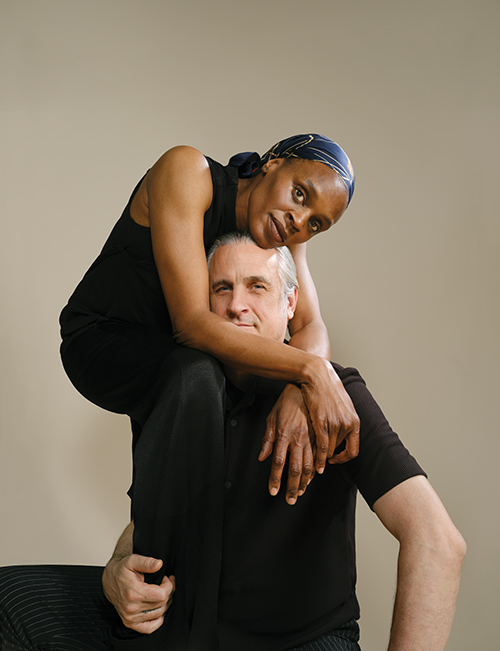
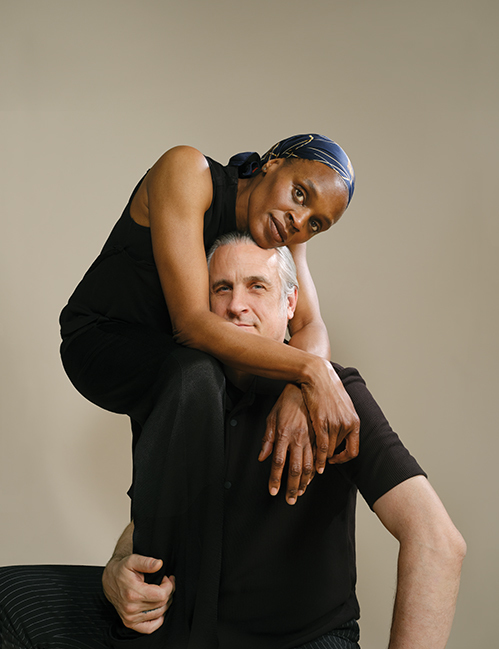
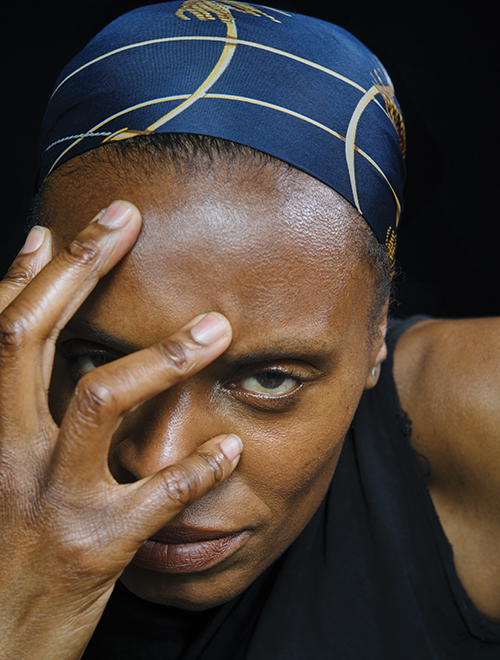
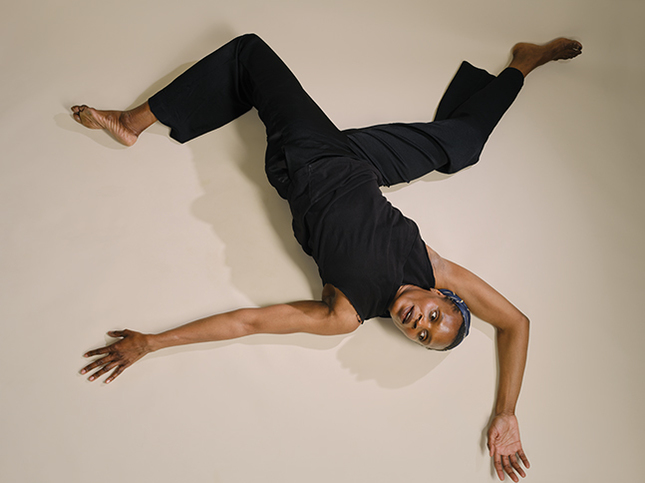
MacArthur-winning performer Okwui Okpokwasili ’96, shown here with her husband, director Peter Born ’95.
View full image

Chris Buck
MacArthur-winning performer Okwui Okpokwasili ’96, shown here with her husband, director Peter Born ’95.
View full image
Chris Buck

Chris Buck
Chris Buck

Chris Buck
First, I saw her play Death. Okwui Okpokwasili ’96, who later conjured the acclaimed dance/theater/sentience group Sweat Variant with her husband, director/designer Peter Born ’95, barged into my awareness in the summer of 2001, when I reviewed, for the Village Voice, a production of Jean Cocteau’s Orphée (one of my favorite plays), in which she, a smooth, dark, statuesque Nigerian American, played the part of Death in this French update of the Orpheus myth, wearing long black gloves and walking through mirrors in dimly lit silence. I called her “strikingly beautiful” and her casting a “stroke of . . . genius.”
Just two years after I saw Orphée, I found myself collaborating and performing with Okwui and several others under the wing of multidisciplinary guru Ralph Lemon on a piece that would eventually become Come home Charley Patton. As part of our research, we watched multiple mind-bending, glacially slow Tarkovsky movies together and weathered bizarre improvisations based on Ralph’s prompts. One day, he poured a glass of half and half and, handing it to Okwui, announced, “This glass of milk represents the Middle Passage.” Almost immediately, Okwui lay down on a wheeled, gurney-like prop, balanced the glass between her bare feet, and, as she lurched the gurney from right to left across the stage with her hips (as if traveling east to west), lifted the glass awkwardly to splash the liquid over her face, which proved creamy enough to form a white mask. It was sheer genius—an entire Frantz Fanon essay compressed into a three-minute improvisation.
Since then, the art and performance world has watched Okwui take the helm and seen her brand of ingenuity, spontaneous and otherwise, intensify and explode. In fact, she has become a certifiable genius, having won a MacArthur Fellowship in 2018, and with Peter, has gathered further accolades to spin the head: multiple Bessie Awards; performances in Paris and Zagreb; museum and gallery installations in Los Angeles, Norway, the Venice Biennale; and the occasional Hollywood foray—as an infected zombie in I Am Legend (2007), as an Eartha Kitt–inspired love goddess in the video for Jay-Z’s “4:44” (2017), and as a witch named Vertigo on the Disney+ series Agatha All Along (2024). Last year, Okwui played the black-veiled, Death-like title character in the horror feature The Woman in the Yard (2025).
A path from Nigeria to Yale
Genius runs in the family, apparently, and so does Yale. Okwui’s father, Bertram Okpokwasili ’67, encouraged by a post-colonial soft power scholarship from a USAID-funded organization, came to Yale in 1963 as an engineering student. “His plan was not to stay in the United States,” Okwui tells me, “but my family is from Biafra.” The Biafran Civil War broke out in Nigeria mere months after Bertram’s graduation, so he did not immediately return. He left Ezra Stiles College behind, moved to New York, got a master’s from Columbia, and worked for IBM and later taught at Georgian Court University’s School of Business and Digital Media. The Nigerian civil war ended in 1970, but by then he’d had a child with his wife Eunice, an office administrator with an MBA from Baruch who’d come from the same village in Nigeria. Okwuchukwu Adannia Okpokwasili, the third of their five kids, arrived in 1972.
Her parents went to court in order to get a place in the Bronx’s Parkchester Apartments, a complex built for middle-class families completed in 1941, and became one of the first Black families in the neighborhood. During that time—unlike her siblings—Okwui found herself drawn to theater. The family moved to New Jersey when Okwui was 15, and at that point she attended the Freehold Performing Arts Center for high school. “I thought about going to a conservatory [afterwards], but I needed Yale so I could look at all the different ways I could be a performer.”
Peter’s first Okwui encounter happened while he was trying to learn French in the Language Lab. A Madison, Wisconsin, native, he had recently transferred into Yale after stints at Bethany Lutheran College and the American Academy of Dramatic Arts. She walked in and, he says, “I was deeply struck by her presence.” They randomly ended up in five classes together during his senior year, then she performed in his senior project, he directed her senior project, and one thing led to another. In 2003, they married. Their daughter, Umechi, was born in 2011.
Sweat Variant’s hybrid aesthetics have a basis in theater, but they cross over into that space where movement and dance become one, or perhaps a third, less definable thing for which there is no name other than being. They harken to many diverse traditions and hold them up next to the contemporary avant-garde, evoking the durational work of artists like Tehching Hsieh, the performances of Afro-Futurists and/or Pessimists like Ralph Lemon, Urban Bush Women, and Pope.L, and breathe alongside experimental theater and dance practitioners like Richard Foreman ’62MFA, Sarah Michelson, and Trajal Harrell ’90. Okwui has worked extensively with Lemon, calling him “my North Star,” and credits him with a heavy influence on her methodology, especially with regard to “the ethics and generosity he shows in bringing people together.” Lemon facilitated her escape across the imaginary demilitarized zones dividing theater, dance, and visual art.
Sweat Variant shares with some of these artists an interest in upending audience expectations by drawing out simple actions over long periods of time—their Bronx Gothic (2014) begins with a half hour of Okwui shaking and sweating, an action she has described as “twerking gone horribly wrong”; in Lemon’s How Can You Stay in the House All Day and Not Go Anywhere? (2010), Okwui spends eight minutes legitimately crying with her back to the audience. For Lemon, this seems like Afro-Tarkovsky, but Okwui and Peter return that stretched-out sense of time directly to its African roots. Repetition and duration become portals into a groove, and the groove morphs into a trance, like one of those 15-minute Fela Kuti songs. Twentieth-century Western art appropriated much of its mojo from encounters with African art and music (think Cubism, rock and roll); Sweat Variant reverses that flow by foregrounding a modern, reimagined African-ness in conversation with Blackness (they aren’t the same thing), jewel-boxed within Born’s elegant, minimalist environments.
Rehearsal as collective imagination
In keeping with this re-Africanization of the avant garde, the all-Black femme cast of Sweat Variant’s adaku, part 2, a rehearsal of which I’m watching in SV’s Sunset Park Brooklyn rehearsal space/studio, circle the room repeating a series of small movements à la Judson Dance Theater pedestrianism—or is it African kwassa kwassa?—while engaging in a call-and-response chant led by Okwui, making rhythms with their hands and feet along with mysterious music played on speakers. Peter’s explanation for Sweat Variant’s mission just puts icing on the cryptogram: “[We] create an active landscape for performers and audience to engage in a psychic, spiritual, physical, and intellectual proximity of exchange.”
Hard to envision without seeing it in action—but fortunately, adaku: part 2 will premiere in October at the Wexner Center for the Arts, along with an installation of new Sweat Variant artworks, before moving to the Brooklyn Academy of Music and then the ICA Boston. Yale is a commissioning partner, so they performed the work in progress at the Schwarzman Center in April, and a future performance at Yale is in the works.
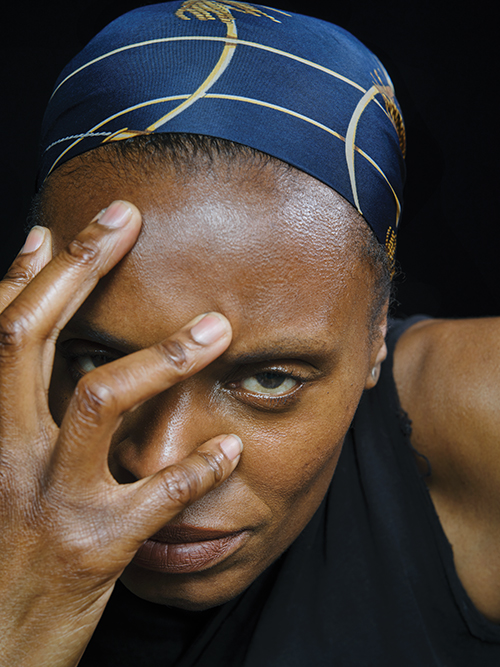
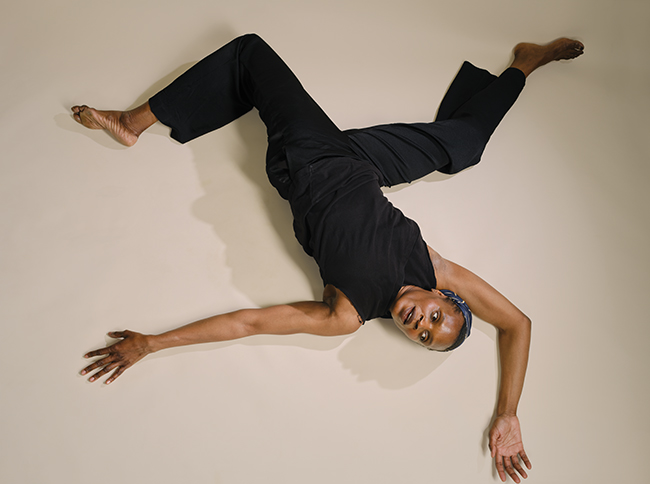
Black female embodiment is central to Sweat Variant’s mission—centered around Okwui’s incredible rubber-band physicality—as are community and music, but the group undergirds their performances with audacious, wildly complicated, and often shockingly funny narratives. Shocking because they expose, often in an earthy, unbridled, even sweaty and profane way, truths about all lives, while centering Black female experiences. Black women finally get to see themselves, and everyone else gets to experience—viscerally—the depth of Black female humanity.
For adaku, Okwui doles the tale orally to the cast over the course of the rehearsal; she becomes a kind of griot, a shaman—sha-woman?—and the performers take on the roles of listeners, collaborators, and performers all at once. Okwui is emphatically directing today’s proceedings; at a certain point she will jump into the ensemble. The understory of the adaku trilogy concerns a woman in pre-Colonial Africa, like Okwui, an eldest daughter—the name Adaku means “daughter of wealth”—whose mother experiences a premonition of the horrors of colonialism that no one in her community can fathom; they of course blame the messenger and banish her. An ocean of Mylar overwhelms the stage in another metaphor for the Middle Passage. Though her family is supportive, especially when awards are involved, Okwui’s mother, she says, “doesn’t see how I’m having a good time and asks me, Is that really dance?”
The adaku trilogy is “a story about a family plagued by disappearances, proverbial floods,” Okwui tells the cast. She has written it out, but instead of passing out a script, she describes the story to the performers and has them improvise their own versions of it; she throws an aside to me explaining that this is a way of seeing what is activated in their memories. The first part of this second section of the adaku trilogy has to do with a tragic hair appointment that ends in baldness, after which a mysterious, seemingly unhoused conjure woman appears. This magic personage can regenerate hair in minutes: “She touched the girl’s bald head and then her hair grew,” after which she flees the scene. The protagonist expends a lot of effort to find her—understandably, as she’s the best beautician ever. The hair grows back and transforms itself into a spiritual antenna.
Sweat Variant’s process deliberately keeps the work open-ended for as long as possible: while in development, when it gets shown for the first few times, when it premieres, possibly in your mind after you’ve seen it. In this way their work makes the barriers between life and ritual, reality and performance, not just disappear, but become irrelevant. The stories unfold, the questions they raise have no answers, and the work never resolves what it proposes, with the understanding that their art builds a frame around the enigma of life. “I’m heavily invested in sensation and feeling the weight of others, and then tracing that weight,” Okwui says to me at one point in the rehearsal, while holding her script in one hand. “But narrative seems incredibly important to you as well,” I can’t help pointing out. “I’d be the last person to say that those things are separate,” she counters. “You can have both. You can have it all.”
 loading


 Print
Print Email
Email