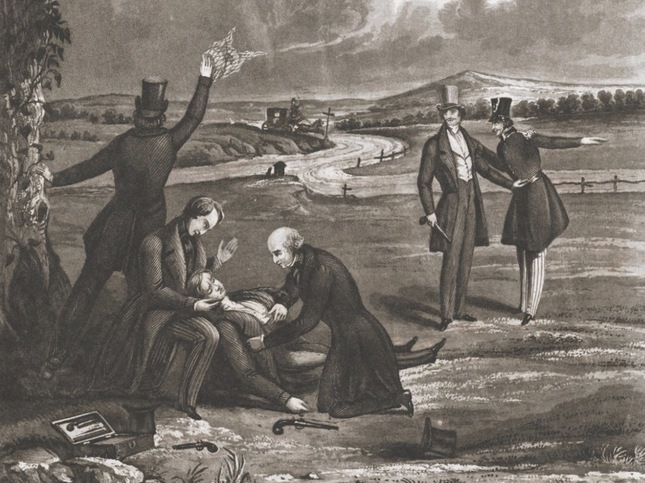
George Dawe, 1781–1829, printer, London
From “The Life of a Nobleman” comes the tragic illustration: “Scene the Eighth: The Duel.” Part of the Lewis Walpole Library archives, the book was published by a London printmaker in the early 1800s.
View full image

George Dawe, 1781–1829, printer, London
From “The Life of a Nobleman” comes the tragic illustration: “Scene the Eighth: The Duel.” Part of the Lewis Walpole Library archives, the book was published by a London printmaker in the early 1800s.
View full image
During my years at Yale, I grew fascinated by dueling as an extralegal means of conflict resolution. While historically many Americans abhorred the practice, others revered it. In fact, Yale president Timothy Dwight IV, Class of 1769, lamented in an 1804 sermon that “duels in great numbers are fought . . . and the miserable victims of wrath and madness are hurried to an untimely end.”
Curious how deeply dueling infiltrated Yale, and enrolled in a seminar titled Yale and America led by Jay Gitlin ’71, ’74MusM, ’02PhD, I contacted James Kessenides ’03PhD, the Kaplanoff Librarian for American History, who directed me to a 200-year-old letter in the Beinecke Rare Book and Manuscript Library. Enthralled, I unfolded the letter written by James Creighton Odiorne, Class of 1826, from Yale College, dated April 15, 1824, to his classmate Samuel Warren. Odiorne began by bemoaning the “mores” of his time, conditions that, to my fascination, facilitated a duel between Yale students. That morning at Beinecke, I realized the culture of honor that sanctioned violence to resolve grievance had, in fact, breached Yale’s walls.
It was a rumor that sparked the tragedy. In the early 1820s, enmity erupted on campus between, as the New-York Observer maintained, “room-mates at Yale College,” James Cogdell and James Wigfall, both of whom hailed from South Carolina. Wigfall flew into a rage when he heard that Cogdell had spread word that Wigfall’s grandfather was a tailor—a potentially mortifying revelation for a young man on the rise. He was surely humiliated. And as Odiorne recounted, Wigfall was “too proud to bear it.” Although roughly one out of every ten Elis hailed from the South in 1800, and students coalesced around regional identity, class distinctions—while malleable—still caused rifts. Julian Sturtevant, Class of 1826, maintained that “Southern students often found that the close relations with the sons of small farmers and mechanics in which they found themselves, were very distasteful to them.”
Fearing the consequence of gossip, Wigfall sought to safeguard his social standing, and thus his future, by the method many Americans then knew best: the ritualized armed combat known as a duel.
Dwight’s stand against violence
Yale alumni had tried to counteract dueling’s beguiling lure. This included lexicographer Noah Webster, Class of 1778, who had established an essay prize, awarded from 1791 to 1795, with a striking proviso: “that no person shall be entitled to the Premium aforesaid . . . who shall have been known to have ever given or received a Challenge to fight a Duel.” Years later, in the chapel of Yale College on September 9, 1804, Dwight delivered a rousing rebuttal of dueling. His sermon, titled “THE FOLLY, GUILT, AND MISCHIEFS OF DUELLING,” was delivered only two months after the Burr-Hamilton duel, during which Dwight’s first cousin, then vice president Aaron Burr, killed Alexander Hamilton.
Dwight implored the Yale community to “hunt [dueling] out of the world.” He rejected the claim that dueling served a social good, instead declaring that “wherever fighting becomes the direct and chief avenue to glory, no occasion on which it may be acquired will be neglected.” Such a culture, he argued, would incite conflict, obscure truth, and unravel the nascent republic. A nation required law, not violence, as the arbiter of justice. As he proclaimed, “truth and falsehood must . . . be evinced by evidence; not by fighting.” Duelists, Dwight maintained, were “overbearing . . . quarrelsome, and abusive,” and by succumbing to their code one “can gain no applause, but that of fools and sinners.” Accordingly, Dwight condemned dueling as “foolish, irrational, and deserving only of contempt.” Whereas the code of honor cast bravery as the willingness to fight, Dwight redefined “genuine bravery” as the courage to resist public pressure.
Dueling was transported to America from Europe. The practice descended from the judicial duel, which sought to determine the “truth” of a case through combat. As Dwight explained, “in the days of knight errantry . . . God was then believed to give success, invariably, to the party which had justice on its side.” In 1784, Benjamin Franklin confirmed in a letter to Thomas Percival that duels once decided lawsuits on the belief that “Providence would in every Instance favour Truth and Right with Victory.”
By the nineteenth century, few still believed in divine intervention. But dueling persisted to police reputation. Honor meant everything: “A man without honor was no man at all,” writes Joanne Freeman, the Alan Boles, Class of 1929, Professor of History. The code of honor demanded mastery over emotions, fidelity to one’s word, and an unflinching defense of one’s name. Because honor existed by public perception, even the slightest insult, innuendo, or disrespect could marshal men to a duel. Men risked their lives to defend their delicate yet indispensable reputations.
Young and reckless
Not every slight required a duel. In the letter I read, Odiorne asserted that the Cogdell-Wigfall enmity arose “from some slight cause,” suggesting violence was not inevitable. Nonetheless, Odiorne recounts that upon hearing that Cogdell spread the rumor, Wigfall stormed into his friend’s room “with two loaded pistols, presented one of them to him and commanded him to fight across the table.”
Despite the brazen challenge, Cogdell declined to fight his classmate—a refusal that could itself be construed as a further slight, since men were bound to duel only if they regarded the challenger as within their social class. Denied the opportunity to reclaim his pride, an incensed Wigfall demanded that Cogdell “acknowledge himself (in writing) to be a base fellow and a coward” for refusing to duel. “Coward,” Freeman notes, was a “fighting” word. A confession substantiating dishonor could be ruinous. Unsurprisingly, Cogdell resisted putting pen to paper. Wigfall then brought out a whip and lashed him until he signed the statement.
In contrast to Wigfall’s adherence to a violent code, Cogdell demonstrated faith in the legal system to redress grievances. After the assault, he took out a writ against Wigfall for “an attack upon his person,” and, as Odiorne recounted, “left the city and returned home.” Their clash at Yale was over. But the flames of their hostilities were about to be fanned.
Code of honor
It’s clear that the duel that would visit tragedy upon them would not have occurred without the intervention of male elders. Cogdell had left New Haven; a duel was not in the cards. But when Cogdell’s father heard of the clash, Odiorne writes, “he was so enraged that he sent for his son to return home and commanded him to challenge Wigfall.” As the North Star in Vermont reported, Cogdell was “enforced by his own father! To challenge the aggressor, by a threat that if he did not, he must never again presume to look him in the face.”
Coerced, the reluctant Cogdell issued the challenge.The stage was set, but not the conditions. And negotiations reveal an insecure Wigfall. Upon accepting the duel, the New-York Observer reported that Wigfall asked they be “shut up in a room together, and should fight with dirks [daggers],” which was deemed an “unusual” request. Gentlemen did not engage in knife fights—that kind of fighting was reserved for perceived social inferiors who might eye-gouge or dismember adversaries.
Next, Wigfall refused pistols and instead proposed rifles. As South Carolina’s Hamburg Gazette reported, rifles were “the most desperate and deadly weapons.” An elite man would not have insisted on anything that elevated the risk of fatality; a regular pistol duel would have sufficed. The fatherless Wigfall’s behavior paints a picture of a young man desperate for approval. He seemed to hope that manifesting manhood through extreme demands like these could salvage his fragile familial reputation.
Cogdell strove to mitigate harm at every turn, even as his father and Wigfall and stoked the flames. During negotiations, Cogdell’s second refused rifles. Shockingly, officers in the army then took charge. The Gazette denounced the interference: “Revolting as it may appear, yet there are men to be found who lend their aid and countenance to this horrid practice.”
Despite increasing the risk that one of the students would die, the officers “decided in favour of the rifle.” The conditions were settled. The duel was to take place at the US arsenal in Augusta, Georgia, on Thursday, March 25, 1824, with rifles, at a distance of thirty paces. A variety of older men had facilitated the awful moment. Now two students would enter the field of blood, surely terrified, as the army oversaw. The code of honor had fully ensnared the young men.
Cogdell and Wigfall began taking strides away from one another, their futures about to be forged. Moments later, the Gazette recounted, “at the word fire young Wigfall received his antagonist’s ball below the breast bone, which came out on the right side between the second and third ribs, having touched the liver in its course.” Witnesses were surely aghast when Wigfall collapsed to die a slow, excruciating death the next day. Odiorne reported that Wigfall’s widowed mother was forced to mourn her only son, becoming, in the words Dwight used to portray mothers bereaved by dueling, “that matron wrung with agony.” And while Cogdell survived, there were no victors. He endured the weight of killing his classmate, however reluctant his participation. As the Anderson Intelligencer affirmed: “the affair was deeply regretted by all, and by no one more deeply than Cogdell himself.”
The code of honor scorched everyone who had been lured into its orbit.
A Southern scourge
Despite news of a classmate’s death by dueling, the morality of the practice invigorated campus debate for years. By the early 1800s, all students belonged to a literary society—Linonia or Brothers in Unity—and their debate records are a good reflection of student sentiment. In 1784, Brothers in Unity debated “whether the practice of duelling is consistent with true honor and propriety,” a question decided in the negative. By 1806, the society’s focus had shifted from honor to criminality as members considered if “the duelist [should] be punished as a murderer, [which] occupied considerable time and was decided in the affirmative.” Yet the issue still kept cropping up. In 1839, Brothers in Unity asked, “Ought homicide by dueling to be punished as murder?” This time, they passed the affirmative by a slim margin of only one student. Students were clearly conflicted.
Southerners surely supported dueling more than their Northern classmates. In 1819, Yale’s Southern students formed a third literary society, the Calliopean Society. Wigfall is listed as a Calliopean member on October 30, 1822, and in the margin, the secretary returned to note: “killed in a duel.” Yet Calliopean members in 1838 questioned “should duelling be prohibited by law?” And dueling continued, albeit not involving students. Yale’s Confederates: A Biographical Dictionary details five duels involving Confederate alumni between 1832 and 1862.
The same code of honor may have promoted the Civil War. Dwight had warned that if dueling was not annihilated, then “every controversy, every concern of man would be terminated by the sword and pistol. Civil war, war waged by friends and neighbors, by fathers, sons, and brothers . . . would ruin every country.” Saint Louis University historian Lorri Glover is unsurprised that Southern college boys grew up to become the “architects of southern nationalism and the instigators of civil war,” due to their obsession with social reputation dependent on combat.
In particular, Wigfall hailed from Edgefield County, described as possessing a character “more intense, more fiery, than was found elsewhere.” Circuit court judge Aedamus Burke expressed alarm at the prevalence of eye-gouging in the South Carolina upcountry: “There is a plaintiff with an eye out! A juror with an eye out! And two witnesses with an eye out.” Bloodshed, woven into the fabric of early America, was especially rife in the South due to the practice of slavery. The Southern code ingrained in Wigfall that bloodshed could resolve grievance and restore reputation.
If elders had championed Dwight’s anti-dueling message and shepherded the students through the quotidian clashes of young men, a bullet would not have torn through Wigfall’s ribs. Instead, they facilitated, even demanded, that the two youths—whom the Hamburg Gazette described as “scarcely ripened to a sense of their danger”—engage in what would prove to be a fatal tragedy.
Students still contend with the remnants of this violent code of honor. A bar brawl is not considered honorable, but if two people take it outside and have a fair fight while friends oversee, it’s seen as more respectable—a modern-day dueling equivalent. As Barbara Holland maintains in Gentlemen’s Blood, “a duel in its final, degraded, vestigial form . . . [is] deeply ingrained in social life, with a thousand years of history.” Dueling waned. But its legacy persists.
 loading


 1 comment
 Print
Print Email
Email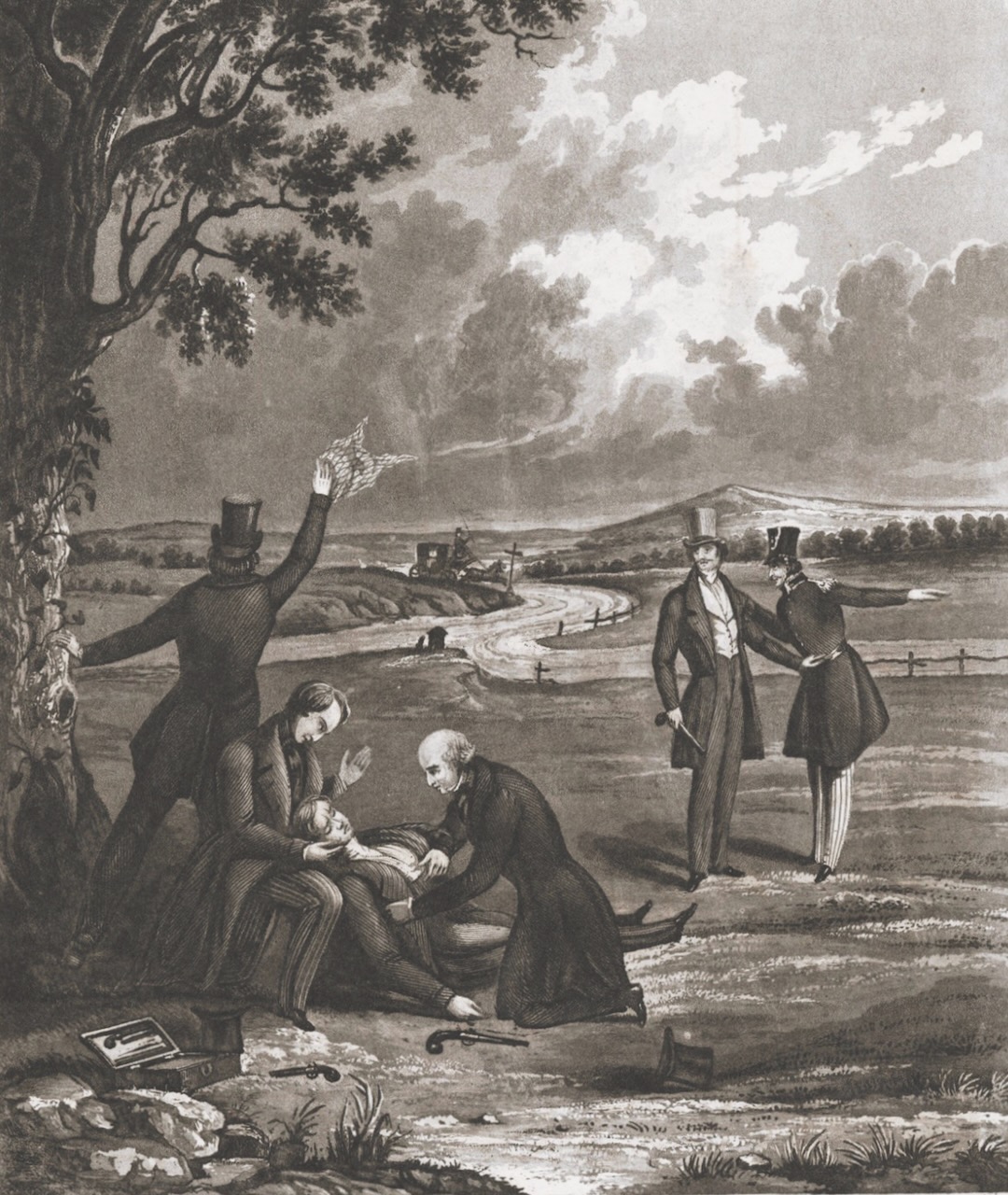
1 comment
-

Lori Ginzberg, 2:08pm May 06 2026 |  Flag as inappropriate
The comment period has expired.Readers of this interesting article might be curious about some more Cogdell family context, in particular James's father's children with an enslaved woman, Sarah Martha Sanders. In my recent book, "Tangled Journeys: One Family's Story and the Making of American History" (UNC Press, 2024), I mention the duel described in much greater detail here, but the story I tell is centrally about Richard Cogdell's relationship with his formally enslaved children and their lives in Charleston and Philadelphia.
Lori Ginzberg
Prof. Emeritus of History and Women's, Gender and Sexuality Studies
Penn State University
(Yale PhD 1985)