Yale University Art Gallery
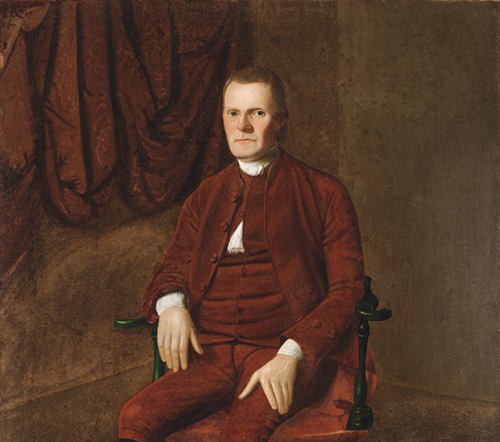
Roger Sherman’s plain mode of dress, depicted here in a portrait by Ralph Earl, contrasted with his more fashionable peers and reinforced his reputation for common sense.
View full image

Yale University Art Gallery
Roger Sherman’s plain mode of dress, depicted here in a portrait by Ralph Earl, contrasted with his more fashionable peers and reinforced his reputation for common sense.
View full image
If, in this semiquincentennial year, you want to rank America’s founding fathers in terms of their influence, you have to put New Haven’s Roger Sherman (1721–1793) in the top ten. Sherman is the only person who signed all four of the nation’s founding documents. He served in some form of national legislature nearly continuously from 1774 until his death, and he proposed the compromise that allowed delegates to agree on the United States Constitution in 1787.
Every year on the Fourth of July, Sherman is honored at the Grove Street Cemetery with a twenty-one–gun salute and the laying of wreaths on his grave. But outside of New Haven, Sherman is far less well known than his peers. He has never inspired a blockbuster biography, much less a Broadway musical. (He does get a few lines in 1776, in which he sings that he is “just a simple cobbler from Connecticut.”)
His PR problem? Sherman was by all accounts a sober, pious man, a strict Calvinist who left behind no colorful tales. No kite-flying in thunderstorms. No cherry trees. No duels.
Sherman had neither the elevated family background nor the education of most of the other founders, who noted for posterity his awkward speech and manners. “Sherman’s air is the reverse of grace; there cannot be a more striking contrast to beautiful action than the motion of his hands,” wrote John Adams after watching him address the First Continental Congress in 1775.
Later, William Pierce of Georgia recorded his impressions of Sherman at the 1787 Constitutional Convention: “He is awkward, unmeaning, and unaccountably strange in his manner. . . . The oddity of his address, the vulgarisms that accompany his public speaking, and that strange New England cant which runs through his public as well as his private speaking make everything that is connected with him grotesque and laughable.”
But both men would express their admiration for Sherman. “And yet he deserves infinite praise—no man has a better heart or a clearer head,” concluded Pierce. Decades later, Adams recalled Sherman in similar terms in a letter: “Destitute of all literary and scientific education, but such as he acquired by his own exertions, he was one of the most sensible men in the world, the clearest head and steadiest heart.”
As Adams suggested, Sherman was self-educated, the son of a farmer and cobbler in Stoughton, Massachusetts. His father died when he was 20 years old, and in 1742 he joined his brother in New Milford, Connecticut, and took up shoemaking himself. His aptitude for mathematics quickly won him a job as county surveyor, and he soon got involved in real estate, politics, and the study of law.
Eventually, he settled on the mercantile business, and in 1760 he set up a store on Chapel Street in New Haven, across the street from Yale College. Beyond the usual offerings of a general store, he stocked books on science, religion, politics, and philosophy for the college clientele—and likely read many of them himself.
Sherman threw himself into church and civic life in New Haven, and he befriended Yale president Thomas Clap. He was one of the larger donors to the project to build a college chapel in 1761, and he served as treasurer of the college from 1765 to 1776. Yale rewarded him with an honorary master’s degree in 1768.
As relations with Britain deteriorated and the colonies began to organize, Sherman’s political acumen became apparent. He was not a political philosopher like Thomas Paine or a fiery activist like Samuel Adams; instead, he was, as his biographer Christopher Collier put it, “the consummate politician. His instinct for the possible was not always precise, but it was usually near the mark. . . . His method was compromise, the stock in trade of every successful politician.”
Beginning with the First Continental Congress—where he was a signer of the Articles of Association in 1774—Sherman was always in the room where it happened, with a preternatural skill for seeing where a body of competing interests would eventually find its way to agreement. With a head for detailed committee work, he helped prosecute the war in the Second Continental Congress, where he signed the Declaration of Independence in 1776 and the Articles of Confederation in 1777.
But Sherman’s most famous contribution would come at the Constitutional Convention. The debate between large and small states over representation in the government had threatened the union from the beginning: Should legislative power be shared equally among the states or linked to population?
Sherman, for his part, had proposed a combination of the two as early as 1776 for recording votes in the Continental Congress, but he had been ignored. In 1787, he championed the idea again. In what became known as the Great Compromise or the Connecticut Compromise, states would each send two members to the Senate, but membership in the House would be apportioned by population. The problem solved, Sherman then put his John Hancock on the Constitution, the fourth of the nation’s most important founding documents.
With the founding complete, Sherman spent his last years serving in each of the houses of Congress he helped conceive, as a representative and then as a senator. He was also chosen as the first mayor of New Haven when it was incorporated as a city (the nation’s seventh largest at the time) in 1784.
When Sherman died in 1793, the funeral reflected his status not just as a statesman but also as a citizen of Yale. President Ezra Stiles wrote in his diary that, although the procession included members of Congress, judges, aldermen, sheriffs, and other legislators, “The Students and Tutors of the University formed the Head of the Procession.”
 loading


 6 comments
 Print
Print Email
Email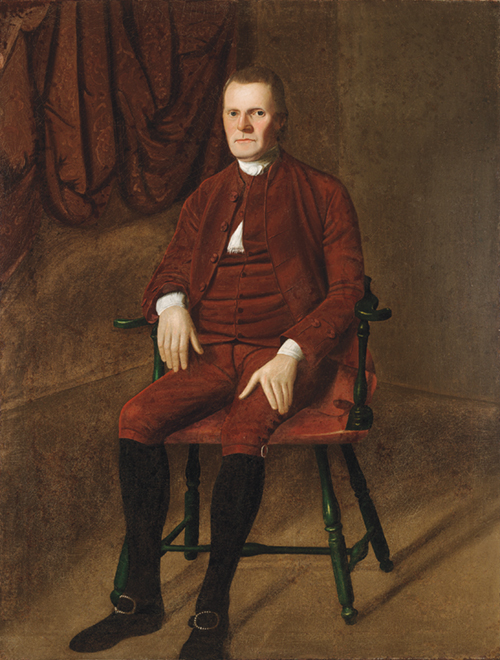
6 comments
Excellent! A Joy to read. Thank you.
BEAUTIFUL account .. so lucid and easy to understand even for a non-US citizen from across the world.
Inspiring,
Enjoyable to read, thank you.
Proud to be his 6th great grandson. Thanks for getting us off 9n the r
ight "foot"!
So proud of Roger Sherman & the Historical Society for this timely exhibit, & to John Celio for his interest and research. Our town is rich in this history and proud of our heritage!
Solid, fun article to read. Roger Sherman signing all four founding documents of America is no small thing. I'm not entirely sure what it means to have a clear head and sound heart on important political matters, but that sounds impressive too!