Doonesbury goes to war
This welcome stroll through Garry Trudeau’s past (“Garry Trudeau Is Still Learning,” March/April) reminds those of us Yalies who served in Vietnam of the tie between comedy and tragedy, a link observed by Aristotle and many others. In 1971, B. D. gave some of us an unexpected but welcome way to make sense of our place in an increasingly irrational conflict. To his great credit, Mr. Trudeau found a way to offer this insight to the next generation of warriors. Many thanks.
Bill Belding ’67
Oxford, MD
I was an RFA: six months active duty, five and a half years active reserve, 1960–66. Never activated. I cried like a baby at several places in the story.
Jim Warden ’59
Philadelphia, PA
As a member of the Class of ’69, I was no longer a civilian when the lottery numbers were drawn, a pity in a sense since my birthday was the penult. On the other hand, it was not a pity at all, not only because I was lucky not to be sent to Vietnam, but also because military service taught me a tremendous amount, especially about humility.
George Penny ’69
Washington, DC
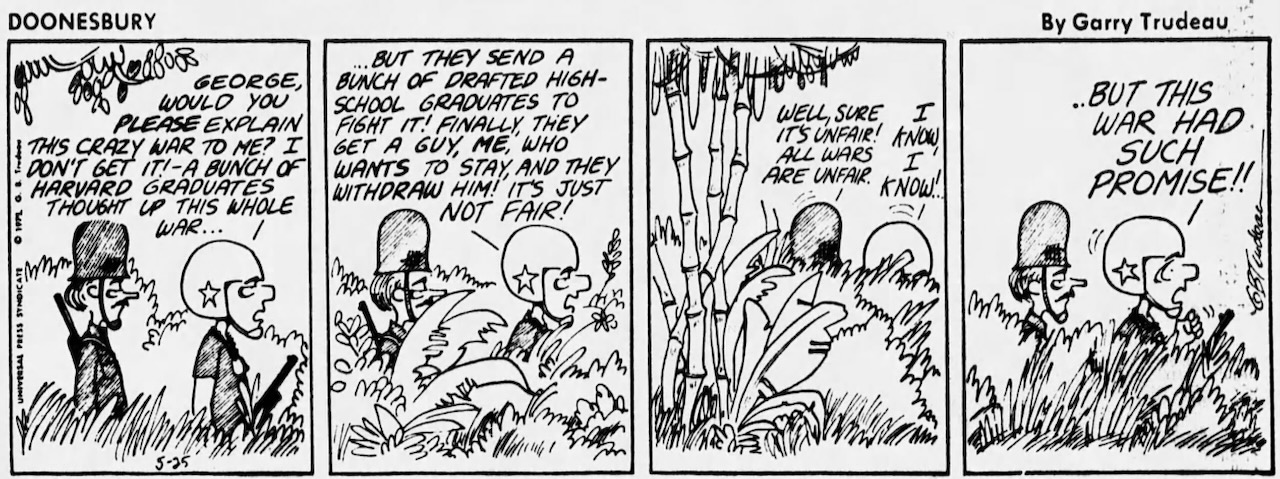
I know the focus of the Garry Trudeau profile in the March/April 2026 issue is on Doonesbury’s post-Vietnam evolution. Still, it’s a shame you omitted what I regard as Trudeau’s greatest Vietnam war strip (below). To me, a Marine veteran of the war and a Yale PhD in art history, that irony-laden cartoon cuts every which way on the issue of whether the war was worth fighting, and the mixed feelings, then and today, of many a man who served “over there.”
Garry Apgar ’88PhD
Bridgeport, CT
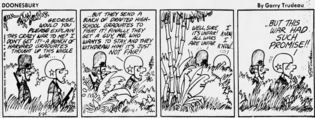
Courtesy G. B. Trudeau ’70, ’73MFA
__________________________________________________________________
Mary Clabaugh Wright
I appreciated your article about my mother, Mary Clabaugh Wright (“Steel Magnolia,” Old Yale, March/April). It was good to speak directly and tactfully about her suffering and time in psychiatric hospitals. And you portrayed the challenges she faced as a woman clearly without being dogmatic. I liked the well-chosen quotations, including the last one from Mr. Fabian, who said that for her, academics mattered.
Duncan Wright
New York, NY
How nice to read about Mary again after so many years. I came from Taiwan to study with Arthur in 1969 and met Mary on the first day I went to see him. She was amazingly kind to me and even wrote me a card, telling me not to feel intimidated but rather to be confident in myself. She said that later in my life, I would realize how important it was that I came to Yale to study. This was the most encouraging experience of my life. I later met her a few more times and learned many things from her. Her untimely death was a great loss to me, as I was planning to take her course the following year.
Thomas Hong-Chi Lee ’74PhD
Wappingers Falls, NY
Rejoining the conversation
I am an enthusiastic user of AirCaps transcribing glasses (“Reading the Room,” March/April). When I first tried the earliest version, several months ago, I declared that this technology is a game changer.
I am an alumnus of Yale College and Yale Law school, many years ago. For many of those years, I had no problem hearing. More lately, with the passing of the years, I lost that ability to hear clearly. I couldn’t follow conversations, and restaurant meals with friends became intolerable. I could hear sounds, but I couldn’t understand. This was confining.
Then I found AirCaps. With them I can now do all those things, simply and unobtrusively. The latest version, which I just received in March, is elegant.
The author of your article is not hearing-impaired, and I hope she is able to stay that way. For her sources, she had to rely on students and professors who had limited availability to the glasses and could provide only modified commentary on them. I hope that in addition to noting the product’s shortcomings, she and they can appreciate the profound positive impact of AirCaps on those of us who now can rejoin the wonderful world around us. Now we can participate through the glasses, instead of through our flawed hearing. For that I am immensely grateful.
Michael Doyle ’59, ’62LLB
Atlanta, GA
Credit where it's due
I enjoyed reading the latest issue of the magazine, and I’ve been grateful for its coverage of both new and legacy architecture at Yale, including the article on the proposed new Dramatic Arts Building (Light and Verity, March/April). The building has the potential to be transformative for both the school and that block of York Street.
However, I was surprised and disappointed that the article did not note that the lead architect at KPMB for the new building is Marianne McKenna ’76MArch, one of the founders of the firm. I realize that sometimes things slip by, but as the magazine serves to communicate to alumni both what is going on at Yale and notable alumni achievement, I’m sorry that this was missed.
Herchel Parnes ’76MArch
Seattle, WA
Lipstick's location
I really love Claes Oldenburg’s Vietnam-era Lipstick (Ascending) on Caterpillar Tracks (“Lipstick Removed,” January/February), and I am glad it will be available for more public viewing in the Art Gallery’s sculpture garden. As a member of the very first Yale class assigned to the then-new Morse College, and the generation to which Lipstick may be most personally meaningful, I never thought it related very well to Saarinen’s architecture. It was—and still would be, especially today—perfect in its original location adjacent to Yale’s war memorial in Hewitt Quadrangle/Beinecke Plaza.
Scott Peterson ’66, ’70MD
Middlebury, CT
Remembering Bob Stern
Robert A. M. Stern (“Big Man on Campus,” March/April) was Vince Scully’s head tutor for History of Art 53b in spring 1964; he was also my (demanding and tough) grader for the course. I was then a senior majoring in English, intent on applying to the Yale School of Architecture.
Both Bob and Professor Carroll Louis Vanderslice Meeks were encouraging to me in my endeavors. In addition to helping Vince Scully run his class, Bob was finishing up work on his double issue Perspecta 9/10 and recruited me to help him with its distribution (in return for copies of all back issues of Perspecta).
I was not immediately accepted to the architecture school, but somehow Bob and Professor Meeks (two men with too many names) arranged for me to become a special student in fall 1964 and spend the next year taking more arts courses and putting together a better portfolio.
During that year, I additionally “apprenticed” myself as a gofer/modelmaker to some folks in Paul Rudolph’s third-year design studio, as well as a couple of thesis students. It was a great preview of what I would be entering into.
Luckily, on my second try, I did enter the master of architecture program in fall 1965, on the cusp of Rudolph and Moore, so to speak. Grateful thereafter, I never failed to greet Bob teasingly as “O Mentor, My Mentor and Tormenter.” Bob always addressed me by all three of my names.
Jeremy Scott Wood ’64, ’70MArch
Chilmark, MA
The Last Look photo of a football player holding a helmet in the air in our January/February issue was credited to the wrong photographer. Our apologies to Daniel Havlat ’25, who actually took the photo.
 loading


 Print
Print Email
Email