Terry Dagradi/Medical Historical Library
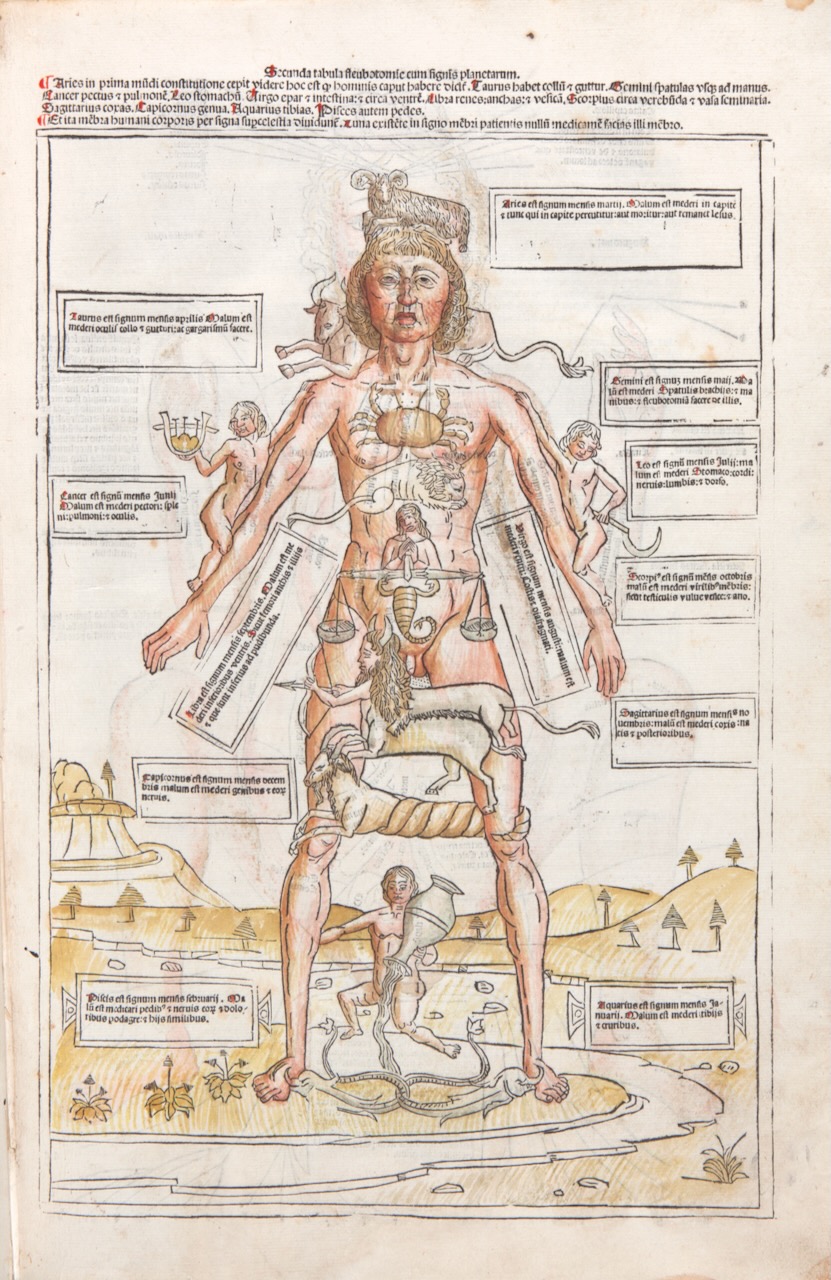
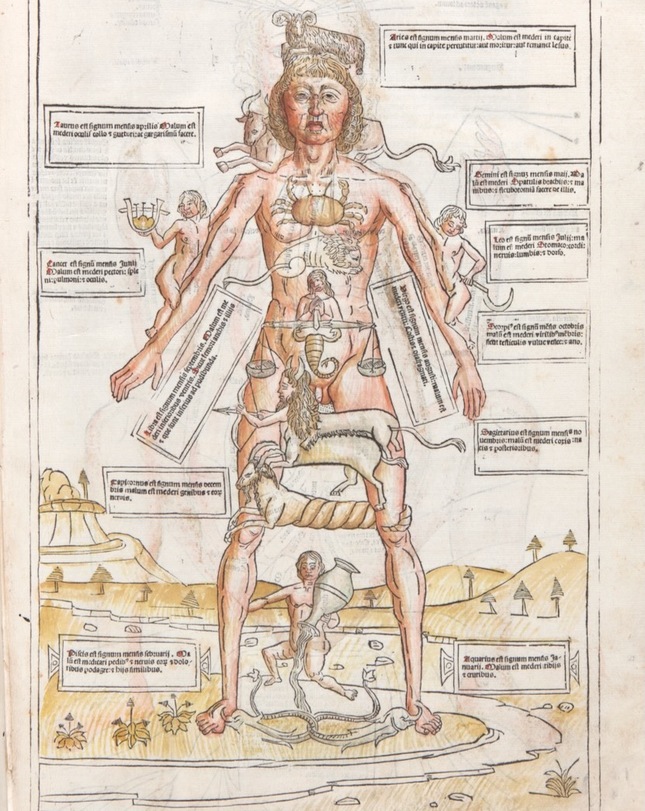
The Zodiac Man appears in the editio princeps of the Fasciculus medicinae, a book widely recognized as the first printed medical treatise to include a series of anatomical woodcuts. The first edition also has something unique: a hidden portrait of one of the most famous artists of the Renaissance.
View full image
Terry Dagradi/Medical Historical Library
The Zodiac Man appears in the editio princeps of the Fasciculus medicinae, a book widely recognized as the first printed medical treatise to include a series of anatomical woodcuts. The first edition also has something unique: a hidden portrait of one of the most famous artists of the Renaissance.
View full image
An important detail in the illustration reproduced here has escaped notice for more than five centuries. The figure—known as the Zodiac Man—appears in the editio princeps of the Fasciculus medicinae, a book widely recognized as the first printed medical treatise to include a series of anatomical woodcuts. The Zodiac Man was one of six full-page prints that not only defined the publication but also ensured its broad appeal, inspiring dozens of editions in Latin, Italian, Spanish, and Dutch. While the second edition of the book has received the most scholarly attention, the first edition has something the others simply do not: Its Zodiac Man hides a portrait of one of the most famous artists of the Renaissance.
That portrait complicates the common understanding of the Fasciculus as a practical physician’s reference, prompting a closer look at the publication, its publishers, and the ingenious visual program that made the book a bestseller. The Fasciculus medicinae, literally a “little bundle of medicine,” was a compilation of six short treatises accompanied by images on topics including uroscopy, phlebotomy, medical astrology, gynecology and obstetrics, surgery, and anatomy. It was first printed in Venice at the end of July 1491 by Giovanni and Gregorio de Gregorii.
Originally from Forlì, the brothers de Gregorii established a press in the competitive Venetian book market by 1483. For most of the 1480s, the Gregorii brothers printed legal texts. But around 1489, the pair pivoted toward natural philosophy and medicine. Their earliest titles in these fields were backed by big names, Albertus Magnus, Avenzoar, and Averroes among them. In this regard, the Fasciculus was an exception. While the colophon attributes authorship to a “Johannes de Ketham,” and revisions to a doctor named “Giorgio Ferrari,” scholars now generally regard it as an anthology assembled from multiple manuscript sources, not as the work of one author.
The ambitious format of the Fasciculus assumes greater importance in the absence of an author. Printed at a turning point for the Gregorii press, the first edition was a unique combination of grand scale and brevity. Unlike subsequent imprints, it comprises a mere 16 leaves, measuring 31 x 45.5 cm (12.2 x 18 inches). The book contains only twenty-nine printed pages, six of which are devoted to full-page illustrations. The content of those illustrations is equally grand. As the Zodiac Man demonstrates, the Fasciculus illustrations marry medieval medical images with a humanist conception of art. They endow familiar didactic diagrams, drawn from fourteenth- and fifteenth-century manuscripts, with a distinctive sculptural grandeur, providing a visible idea of the ancient past and of the classical authorities the text engages. At play in the Fasciculus illustrations is an unmistakable aura of antiquity, which scholars have long attributed to the influence of Andrea Mantegna (c. 1431–1506), court painter to the Gonzaga in Mantua, who was renowned for his antiquarian expertise and artistry.
But Mantegna’s influence on the Fasciculus is not only stylistic; it is also literal. His is the face of the Zodiac Man. His portrait presents the artist as the very figure of influence, visually aligning artistic power with celestial emanation and the stars’ supposed governance of the body. While surprising, hidden portraits of the artist are not uncommon. Mantegna incorporated his likeness into several works throughout his life, including the Camera picta frescoes (1465–1474) in Mantua and The Presentation at the Temple (c. 1455). Positing that it is a self-portrait, the Zodiac Man dramatically expands the visual program of the book together with the figure on its verso: the pregnant female anatomy, in whose countenance a likeness of Nicolosia Bellini, Mantegna’s wife, fuses with the antique portrait he owned of Faustina the Elder. Seen together, the two illustrations establish a striking dialogue between the celestially governed body of man and the generative body of woman. That dialogue emerges through the page with the hands of the Zodiac Man, which graze the tops of his partner’s thighs, and the figure of Aquarius (the water bearer), whose unusual alignment with both bodies claims creation for the male figure on the front by enacting the breech birth of the fetus on the back. In this way, the illustrations work together to animate a subtle signature by one of the greatest artists of the Renaissance.
Visitors to the Metropolitan Museum of Art this spring can see the Fasciculus medicinae in Raphael: Sublime Poetry. The book will be displayed open to the illustration of the pregnant female anatomy.
 loading


 Print
Print Email
Email