Chris Buck

Chris Buck
United Service Organizations
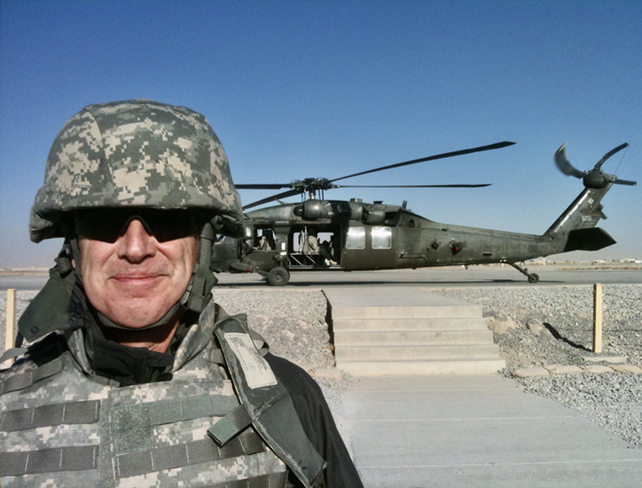
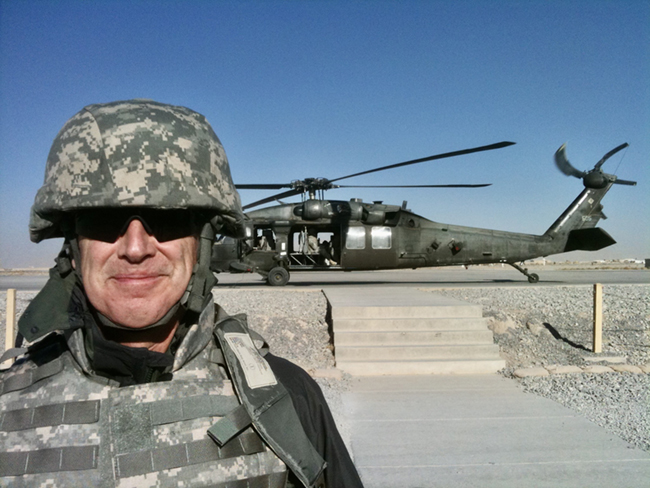
Garry Trudeau on a 2010 United Service Organizations visit to several military bases in Afghanistan.
View full image

United Service Organizations
Garry Trudeau on a 2010 United Service Organizations visit to several military bases in Afghanistan.
View full image
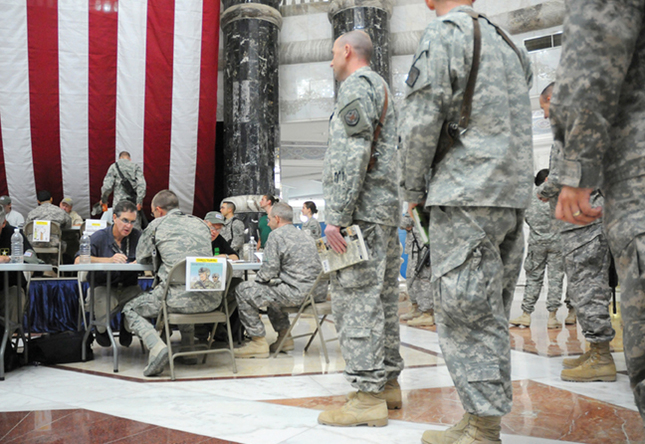
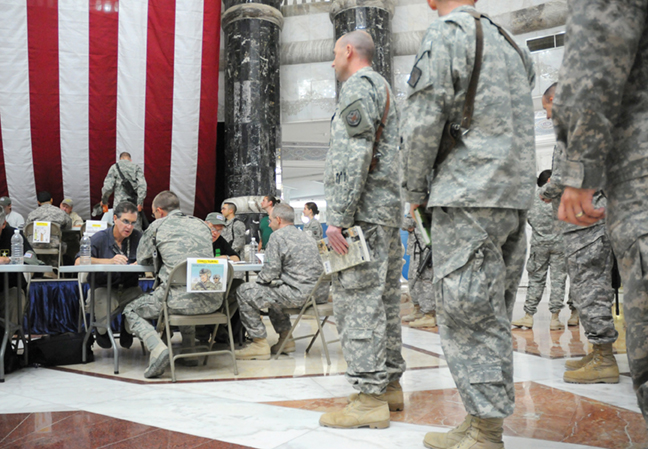
The 2010 tour was part of a long tradition of National Cartoonists Society collaborations with USO. Trudeau has been on several, drawing individual sketches for soldiers as keepsakes, hearing their stories, and visiting the wounded.
View full image

The 2010 tour was part of a long tradition of National Cartoonists Society collaborations with USO. Trudeau has been on several, drawing individual sketches for soldiers as keepsakes, hearing their stories, and visiting the wounded.
View full image
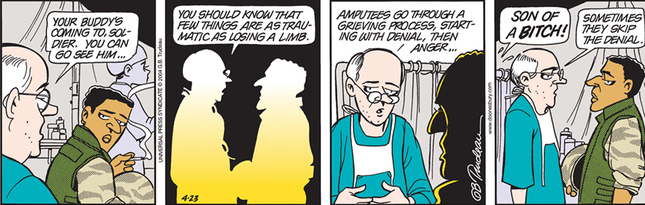
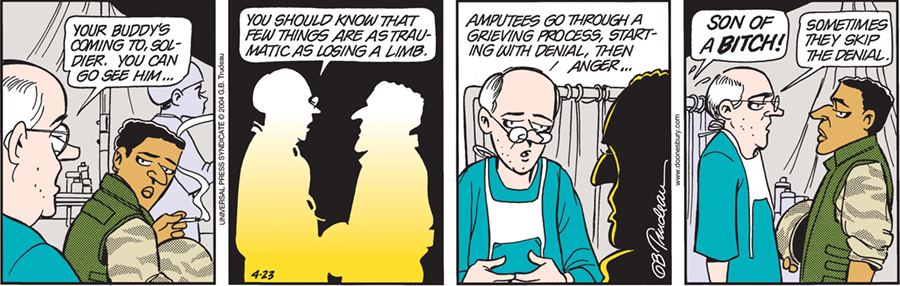
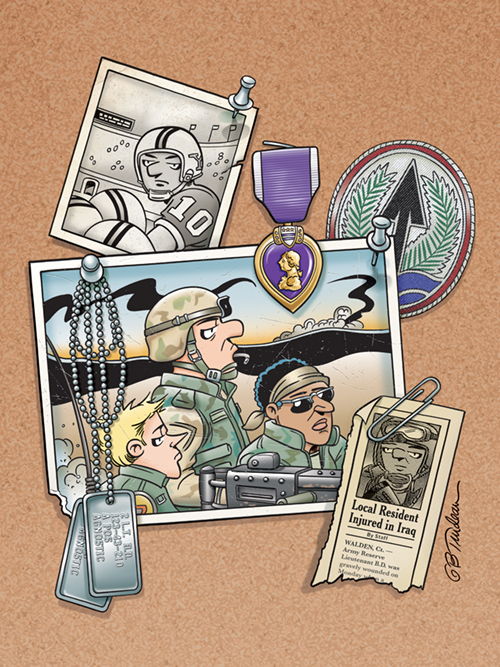
Doonesbury depicted B. D.'s loss of a leg in the war . . .
View full image

Doonesbury depicted B. D.'s loss of a leg in the war . . .
View full image
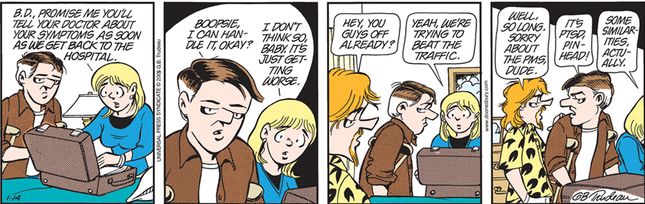
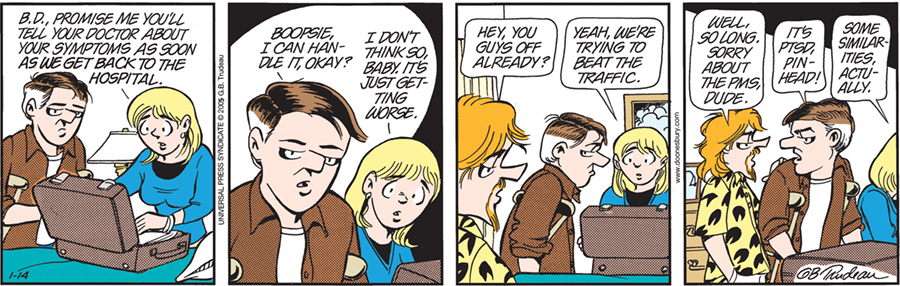
. . . and his struggle with PTSD.
View full image

. . . and his struggle with PTSD.
View full image
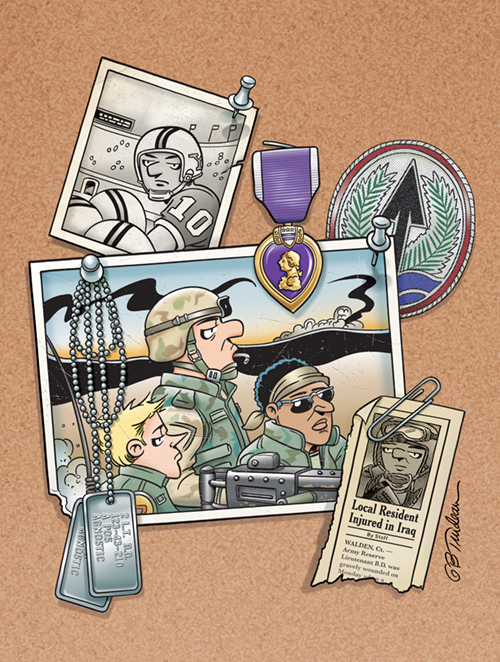
Garry Trudeau ’70
Garry Trudeau ’70
Soon after finishing dinner on December 1, 1969, Garry Trudeau ’70, ’73MFA—along with a group of fellow Davenport College students—huddled together in the college’s common room, anxiously waiting for America’s first draft lottery since World War II. The drawing would determine which young men would be sent to fight in Vietnam.
“I remember the evening with some clarity,” Trudeau says, “having been thunderstruck by my early number, twenty-seven.” The Yale senior had good reason to be alarmed, as more than half of eligible men would receive a draft notice in 1970.
Soon after, Trudeau—a campus celebrity since the launch the previous fall of his comic strip bull tales in the Yale Daily News—drew a self-portrait in which he wore an Army helmet emblazoned with his lottery number. The image illustrated an op-ed he published in the paper later that week, which focused on the dread shared by an entire generation of men whose lives were suddenly endangered.
Though Trudeau assumed that he would be drafted soon after his Yale graduation, he unexpectedly received a medical deferment the following summer. So in October of 1970, he was free to begin working full time on Doonesbury, his nationally syndicated strip modeled on bull tales.
In the early years of his long-running strip, Trudeau repeatedly railed against the Vietnam War. “I got some hate mail for these anti-war strips,” he says. The cartoonist also skewered those who supported the unpopular war, including his central character, B. D., who was loosely based on Brian Dowling ’69, the legendary Yale quarterback. In a famous cartoon published in January of 1972, B. D. enlists in the army to avoid writing a term paper. This absurdist jab captured the cynicism of the era.
But in recent decades, Trudeau’s relationship with the American military establishment has taken a one-eighty. As retired General Richard Myers, chairman of the Joint Chiefs of Staff under President George W. Bush ’68, tells me, “I’m a huge fan of Garry’s many strips on America’s armed forces. They have done an enormously valuable public service.”
The reason that the peacenik of yesteryear has managed to receive such kudos from the military’s top brass—including leaders of wars that Trudeau has adamantly opposed—is that for the past thirty-five years, the cartoonist has been documenting the plight of America’s soldiers with increasing seriousness and empathy. When asked in 2006 why his approach to covering America’s wars had changed, Trudeau replied simply, “When I was writing about Vietnam, I was 22. Now I’m 58. I know more.”
A trip to Riyadh
Trudeau’s understanding of America’s soldiers first began to change after Iraqi troops under the command of Saddam Hussein invaded neighboring Kuwait in the summer of 1990. Like many baby boomers, he found himself reconsidering earlier, absolutist thinking about America’s involvement in foreign wars. As he noted in his sketchbook that fall, the events of the 1980s had shaken up long-standing views about who America’s allies and enemies really were. And Trudeau came to believe that American military power might once again be used to conduct “good invasions.”
When President George H. W. Bush ’48 announced Operation Desert Shield—which involved a build-up of a multilateral force in Saudi Arabia to deter further invasion and prepare for the liberation of Kuwait—Trudeau supported the response. One month later, B. D.—now a sergeant in the National Guard—was deployed to the Middle East. This time around, Trudeau steered clear of overt political commentary. “In the time-honored custom of military humor,” he later explained, “the jokes were at the expense of upper echelons and other, often absurd, forces over which soldiers have no control.”
While enlisted troops embraced the strips, which made them feel seen and heard, most military commanders initially bristled. But by the end of 1990, Army Vice Chief of Staff General Gordon Sullivan, who keenly understood how reading Doonesbury could boost morale, asked Trudeau to curate an exhibition of original strips for bases in the Persian Gulf.
Eager to deepen his understanding of what the soldiers were experiencing, Trudeau had long sought to visit the region himself. Unfortunately, given his unfavorable portrayals of the president, White House officials nixed his efforts to join a USO tour. But in March of 1991—shortly after the end of Operation Desert Storm—Colonel Bill Nash, commander of a tank brigade at Camp Thunder Rock in Kuwait, invited him to visit the base in Riyadh. “The deal was this,” Trudeau says: “Nash would give me the run of the base and let me play with his toys (drive an M1A tank!), but in return, I had to spend the evenings talking with his guys. Who turns down a deal like that?”
An attentive listener, Trudeau formed strong bonds with the troops, who readily confided in him about their fears and frustrations. He later received two medals of commendation from different units in Kuwait because, as he put it, “most soldiers who followed the strip appreciated that someone was recording their day-to-day lives.” In the end, Trudeau wrote a couple of hundred strips about B. D. and his fellow soldiers during the first Gulf War, including one published in May of 1991 that drew a sharp contrast between the warm homecoming they received and the frosty reception given to Vietnam vets a generation earlier.
Even though Trudeau recognized the need for Operation Desert Storm, he worried about its long-term effects. That same May, as Class Day speaker, Trudeau encouraged Yale’s graduating seniors to “wonder aloud what war is like for all its participants. Check out the accounting, what it cost us as a nation. Was it the same for you as it was for the Army engineers who . . . bulldozed 100,000 dead conscripts into the pits left by collapsed bunkers?” The former anti-war activist also reminded the class of 1991 that the euphoria surrounding this war “scares some of your elders to death.”
Forgotten soldiers
Trudeau vehemently opposed the second Gulf War, launched in March of 2003 by President George W. Bush, who as a Davenport senior had lived in the same entryway as the budding cartoonist. Yet Trudeau never wavered in his support for the troops willing to sacrifice their lives for their country. As he noted two decades ago, “I hate this war. Everyone knows that. But it’s not a contradiction for me to value the warrior.”
In November of 2002, B. D.—by then a middle-aged football coach at his alma mater, Walden College—is reactivated; and in February of 2003, he is sent to Kuwait. In pages from Trudeau’s 2003 sketchbook, we see the cartoonist experimenting with themes and punchlines to use as the war heated up.
Five months into the second Gulf War, an army major serving as an intelligence officer in Iraq wrote to Trudeau: “How do you know so much about the military? As much as I’m against your views, I’m intrigued by your knowledge.” Trudeau responded, “Like any writer, I simply try to understand the subjects I write about,” adding that in three decades of Stars and Stripes carrying his strip, “many of the writers, like you, did not share my views. They did, however, think that in a vigorous democracy, contrarian views are indispensable and should be welcomed.”
During George W.’s administration, Trudeau expressed concern about the welfare of all Americans fighting in wars overseas. In a strip published at the end of 2003, the president, as represented by a Roman helmet, makes a surprise visit to a base in Iraq, where he sends his “best to those soldiers in . . . um . . . that other 9/11 place!” Upon reading these words, a fifteen-year-old girl whose uncle was serving in Bush’s other war, which had started two years earlier, fired off a message of gratitude to Trudeau: “I can’t help but feel that a lot of people may have forgotten about those fighting terrorism in Afghanistan, and your cartoon has definitely stated what I’m feeling.”
The wounds of war
In April of 2004, Lieutenant B. D. loses his left leg in a rocket-propelled grenade attack near Fallujah. For the first time in forty-four years, Trudeau depicted his central character without his signature headgear—either football helmet or military helmet. B. D.’s white hair startled readers. When asked a few days later what message he was trying to convey, Trudeau told NBC News: “War has consequences that shouldn’t be hidden. I want to illustrate what it means to have one’s life permanently altered by a disabling wound.”
A month later, in a controversial strip published the day before Memorial Day, Trudeau listed all the names of the more than 700 US military personnel who had died since the start of the second Gulf War. The focal image in that eight-panel Sunday strip featured an army helmet stuck on top of an upright rifle.
With the strip then running in around 1,400 papers, Trudeau would continue to receive many moving letters over the next few years from Doonesbury readers who appreciated his concern for soldiers. In the spring of 2004, the Amputee Coalition of America sent him an invitation to visit injured vets undergoing rehabilitation at the Walter Reed Army Medical Center. He responded right away, saying, “While I’ve done a fair amount of research on my own, there is no substitute for firsthand accounts. I’d be honored to visit Walter Reed, if you think some of the soldiers would welcome a visit from me.” As it turned out, the vets were thrilled by Trudeau’s repeated bedside visits, with one dubbing him “the archangel of Walter Reed.”
As Trudeau soon learned, B. D.’s plight was not uncommon. In fact, according to the Army Medical Command, by June of 2004, 432 soldiers serving in either Iraq or Afghanistan had lost at least one limb. At one of his visits to Walter Reed that year, Trudeau met Staff Sgt. Daniel Metzdorf, who had lost part of his right leg in January of 2004 when he was hit by a roadside bomb in Iraq. As Metzdorf, who ended up spending seven months in the hospital, told Army Times in 2006, Trudeau’s presence provided “such a boost of morale for soldiers.” As the patients went through physical therapy, Trudeau sat quietly, drawing in his sketchbook and taking notes. As Metzdorf also recalled, “He asked us to tell him our stories. He’s found a way to do his own therapy for us.” Every once in a while, added Metzdorf, “you’d see some comment a soldier made show up in his comic strip.”
These on-site interviews enabled Trudeau to expand his coverage of B. D.’s rehabilitation from his physical injuries. The cartoonist also felt duty-bound to do lots of background reporting on the specific challenges that injured vets faced. As he put it, “Not only did I have the imperative of a comedic comic strip writer to make it funny, to entertain, but I also had to get the details right on an extremely sensitive subject, so as to illuminate and to not contribute to the pain that my subjects were experiencing in life.”
In a 2004 sketchbook, we see him thinking through how best to write about B. D.’s new C-leg—his state-of-the-art prosthetic—and the accompanying physical therapy and occupational therapy, which Trudeau covered during the second half of 2004.
Healing cartoons
After B. D. finally returns home at the end of that year, he begins exhibiting all the telltale symptoms of post-traumatic stress disorder (PTSD): flashbacks, crippling anxiety, free-floating rage, and paranoia. In early 2005, after his wife Boopsie observes that all his “screaming at night wasn’t very Christmasy,” B. D. admits he needs professional help. To address B. D.’s state of mind, Trudeau spent countless hours talking to leading mental health clinicians and perused articles about PTSD. As the cartoonist learned, improvement typically proceeds in fits and starts, and B. D. would try both individual and group therapy.
Since 2005, Trudeau has released multiple collections about wounded soldiers. The War Within: One More Step at a Time (2006), which covers B. D.’s first year of PTSD therapy, includes a foreword by retired General Richard Myers. “Garry’s done his research and engaged wounded soldiers,” wrote the man who led George W. Bush’s Iraq invasion, “and his portrayal of their experiences is right on the mark.”
These strips struck a chord with veterans, who began flooding the Doonesbury website with comments that informed 2007’s The Sandbox: Dispatches from Troops in Iraq and Afghanistan. Soldiers opened up about their daily struggles with everything from boredom to the mental and physical wounds of war. Trudeau introduced a new character, Melissa “Mel” Wheeler, an Army aviation mechanic in the second Gulf War who meets B. D. at a VA clinic and becomes an ally in PTSD recovery. In 2014, Trudeau released Mel’s Story: Surviving Military Sexual Assault, a collection of strips aiming to bring attention to the roughly 19,000 sexual assaults that took place in the American military in 2012.
In 2008, the Yale School of Medicine presented him with its annual Mental Health Research Advocacy Award. As John Krystal, the department’s chair, tells me, “For far too long, PTSD among combat veterans was essentially invisible in America. We in the Yale Department of Psychiatry were thrilled to honor Garry Trudeau for his healing cartoons and his advocacy for those afflicted with combat-related PTSD.”
Two years later, the American Psychological Association gave him an award for his contribution to the field of trauma psychology, noting that “characters with combat-related PTSD are shown sympathetically and accurately, allowing his millions of readers to have a more nuanced and compassionate understanding of PTSD suffering.”
Trudeau is descended from three generations of physicians—including Edward Livingston Trudeau, his great-grandfather, who a century and a half ago established North America’s first open-air TB sanatorium in the Adirondack mountains—and with his PTSD strips, the cartoonist feels as if he is following in their footsteps. Upon hearing of one accolade from mental health clinicians, he immediately thought of his forebears who, as he joked, “will rest more easily knowing that I’m to be recognized for finally doing something useful.”
 loading

 17 comments
 Print
Print Email
Email
17 comments
Absolutely superb article about a stunningly original cartoonist. Bravo, joshua Kendall.
This welcome stroll through Gary Trudeau's past reminds those of us Yalies who served in Vietnam of the tie between comedy and tragedy, a link observed by Aristotle and many others. In 1971 B.D. gave some of us an unexpected but welcome way to make sense of our place in an increasingly irrational conflict. To his great credit, Mr. Trudeau found a way to offer this insight to the next generation of warriors. Many thanks.
Bill Belding, Stiles 1967
Great article! As a longtime Doonesbury reader, this really enlightened me about Garry Trudeau’s recent work and achievements. He’s made important contributions re military service and the toll it has taken on so many men and women.
I remenber Gary and are grateful for his humane drawings! Greetings from Oslo, Norway
It is so good to learn about what Garry has done for soldiers, and clearly, what engaging with many of them has done for him. We have learned so much since our Davenport days.
Great article about a Yale legend. I arrived in the fall of 1969 along with the women, the beginning of Yale co-education. We missed the previous November, and the 29-29 tie. But yes, we were there on the first draft lottery night. When it was over, we were all serenaded by a special appearance of the Harkness Tower bells, playing "Happy Birthday." Garry Trudeau was a campus celebrity, even before syndication made him a nationwide celebrity. I was proud of him then, have been proud of him all along, as he expressed for our generation changing views on important subjects.
Will Garry Trudeau’s art be the subject of a BIG path-breaking exhibition at the Yale Art Gallery?
(hint, hint!)
Wonderful piece and a great story of a life devoted to learning.
I got to meet him and his family when they showed up to help his college roommate and a few of us build out his roommate's office in the old Remington factory, a little over 40 years ago. What a day!
I was in the first class of women at Yale. Instead of giving women a dorm of their own, we were scattered throughout the mens' colleges. I was placed in Davenport as Gary was graduating. I met him and thought he was truly a lovely guy. Yes, he was older than I, but it seemed he had an inherent kindness.
Leslie Acoca Goodchild, Yale'72, Davenport.
Thanks for a most enlightening and well written contribution to understanding Garry's relationship with the military.
Very nice article on a very nice guy. I've been following the adventures of Mike Doonesbury, B.D. Zonker, et al. since the strip appeared in the Yale Daily News
Thanks for a lovely article on Garry Trudeau's life and art and his growth as a person over the years. I was a classmate of his in the class of 1970 (Trumbull) but did not know him except through his comic strips in the Yale Daily News. I still have a well-worn copy of the first edition of bull tales, which includes a foreword by Brian John Dowling!
A fascinating, well written article. Thank you, Joshua Kendall, for enlightening me--I never knew all this about Trudeau.
Great article, and impactful transition for Garry! I played football with "BD" at Yale ,and after a Ph.D in clinical psych., ran an Outpatient PTSD Clinic for the VA for about 25 yrs--treating combat vets from WWII, Korea, VNam, and the Middle East. I'd always enjoyed Garry's work while at Yale, and given my focus on how we can add meaning and purpose to life, appreciated reading about the shift in his work.
Thank you!!
I have read the strip since I matriculated (first time I have ever used that word) in 1973. I knew an older student who had served in Vietnam before going to Yale. While I was vehemently against the war, equally I tremendously respected those who served.
Geary Trudeau has always been an empathetic influence on my life.
I loved learning more about Garry Trudeau's journey to learn and enlighten the rest of us about soldiers and veterans. I also chuckled over the fact that this is the most-Yale article ever - the cartoonist and both wartime presidents mentioned are all Yalies.
I enjoyed this great article on Garry T. Followed Bull tales from the start, still have my copy of the first edition of Bull Tales. I was privileged to be "on the field" with BD and Team at every game, as I captained the Yale Cheerleaders, including when I was a YSE grad student at the Harvard 1968 game.