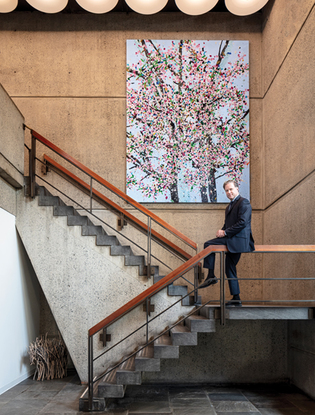
Stefan Ruiz for Sotheby’s
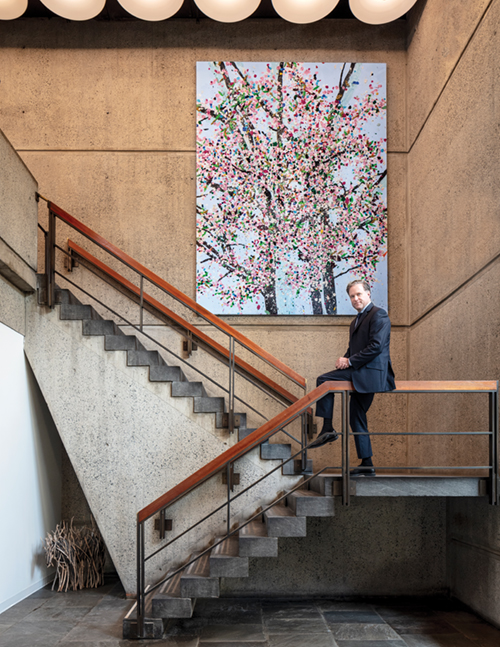
Charles Stewart ’92 is the chief executive officer of Sotheby’s, the 280-year-old auction house now headquartered in the Marcel Breuer–designed former home of the Whitney Museum of American Art.
View full image
Charles Stewart ’92 became chief executive officer of Sotheby’s, the venerable 280-year-old auction house, following a 20-year career in banking at Morgan Stanley and three years working with investor Patrick Drahi. In 2019, Drahi bought Sotheby’s and Stewart took the helm. Four years later, Stewart led the acquisition of the former home of the Whitney Museum of American Art—the iconic Marcel Breuer–designed modernist building on Madison Avenue—as Sotheby’s new world headquarters. Art journalist Hilarie M. Sheets spoke to Stewart about his route to the center of the art world.
Hilarie M. Sheets: Where did you grow up?
Charles Stewart: As a little kid, I grew up in New York City and remember coming in 1976 to the Whitney to see Calder’s Circus. It’s my first memory of an art experience. My family moved to New Haven, where I started fourth grade, because my father became a professor at the medical school at Yale. My mother opened the Folk Art Shop down the street from Modern Apizza.
HMS: When you started at Yale, did you have any idea what you wanted to do with your life?
CS: I come from generations of doctors, so I guess I would’ve said I would be a doctor, which is of course the thing I absolutely didn’t do. It only took me one semester of premed at Yale to realize that was not my calling. I was a history major, and I was in the Whiffenpoofs and played on the varsity squash team.
HMS: Did you ever take any art or art history classes?
CS: I took the Vincent Scully survey course. It started with Greek and Roman columns and went through modernism. He was a brilliant lecturer, and it was just a whole different way of seeing. I took a great photography course with Richard Benson, who was the dean of the Yale School of Art from 1996 to 2006. He thought my work was terrible, by the way.
HMS: Where did you head after graduating?
CS: One consequence of growing up in New Haven and going to school in New Haven is I just wanted to know more of the world. I spent a year in Sydney teaching high school English and then came back to New York and joined Morgan Stanley in one of those investment banking analyst programs. After two years in New York, I was the first employee of Morgan Stanley Brazil. They needed someone to sign the lease. While I was there for three years, I met my wife, who is from São Paulo.
HMS: You had a long career in banking and then helped Patrick Drahi run the telecom business Altice USA. Did the move to Sotheby’s feel like a big leap?
CS: Everybody saw me as this outsider coming into the art world. My wife and I were starting to collect and we considered ourselves as paying some attention, but I thought I knew more about it than I did, that’s for sure. But, on some level, Sotheby’s is a global professional services business, where it’s all about delivering first-class service to your clients. That was the same in investment banking and the clients are the same people. The side that was different is obviously learning about art in depth—and not just art. We sell across 70 categories. I’ve learned about Tiffany glass, I’ve learned about watches, I’ve learned about Korean moon jars.
HMS: Sotheby’s committed to buying the Whitney’s Breuer building in 2023 and its architectural restoration as the art market was taking a downturn. Did it feel like a gamble to do this?
CS: Honestly, no. I understood the significance of this building. I understood the location appeal. People are used to coming here as a museum space. One of the challenges of Sotheby’s has been the threshold resistance factor—how do you get people to come in? Our exhibitions are free and open to the public and have great things to discover.
HMS: I know it’s early days, but how would you gauge the success of your investment in the Breuer building?
CS: In November, when we sold the Gustav Klimts and Maurizio Cattelan’s golden toilet, this place was mobbed. In the ten days the exhibition was open, we received over 25,000 people. Normally that would have been 4,000 to 6,000. The auction week was our second biggest in our history. We did $1.2 billion. Some of that for sure is the market’s improving and we’re capturing that.
HMS: Sotheby’s has announced that it will host the Independent Art Fair in September. Are there other ways you’ll use the building between auctions?
CS: The show Icons [of masterpieces that have passed through Sotheby’s] is an example of where we can go with non-selling exhibitions. Access and appreciation is the first step toward collecting.
 loading


 2 comments
 Print
Print Email
Email
2 comments
-

Kenneth Briggs, 12:11pm March 04 2026 |  Flag as inappropriate
-

Dorsey R Gardner ‘65, 10:16am March 07 2026 |  Flag as inappropriate
The comment period has expired.While Rome burns, good to know the playground of the immunne high rollers is regally kept
You should start with massive show on Art of Iran and the Middle East to
give people an appreciation of what our government is
destroying at this moment in time. You might also show objects purloined
by US and friends from Iraq and the region.
Any proceeds should go to orphans in Palestine, Iraq and Iran.
Your tenure will likely be short but more worthwhile than anything else you can do with your life
catering to the moneyed classes.
DRG