Yale University
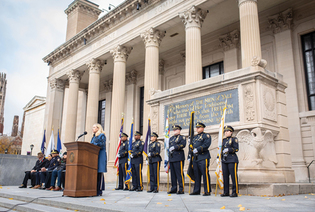
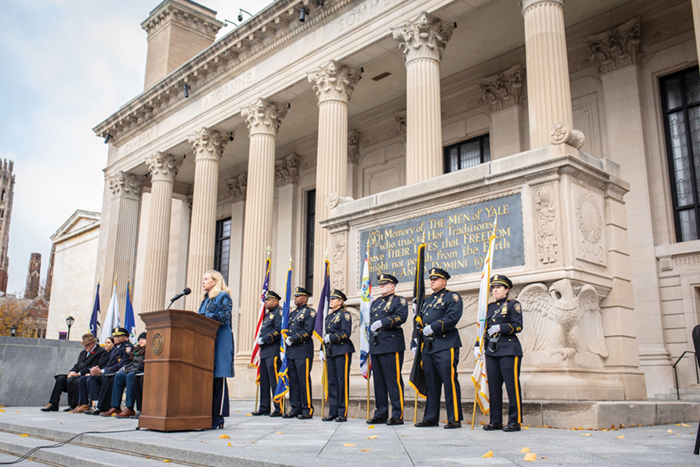
The Yale Alumni Magazine publishes a short interview with President Maurie McInnis ’96PhD (above, speaking at Yale’s 2025 Veterans Day commemoration) in every issue. In this one, the president discusses student veterans with editor Pippa Jack.
View full image
How has Yale’s relationship with its student veterans changed since Garry Trudeau ’70, ’73MFA, was drawing bull tales in his Davenport dorm room?
Things have changed dramatically. Trudeau’s time, of course, was smack in the middle of America’s involvement in Vietnam. Yale closed its ROTC program. It was reinstated in 2012, and now we have approximately 130 ROTC students. Then there’s the Eli Whitney Students Program for applicants who’ve been out of high school for five years. It’s a significant way to bring veterans to campus. We have 58 veterans in Yale College; a decade ago, it was 11. We also have about 150 veterans in our graduate and professional schools, and more than 200 veteran staff members. We’re so pleased to support those who have supported freedom in our country.
Yale’s history of military service goes back to 1701.
When the American Revolution began, half the officers in Connecticut’s militia were Yale graduates. One of the first officers killed in battle in the Civil War was a Yalie. During WWI, our students became some of the earliest naval aviators. During WWII, almost 19,000 alumni fought. These are only a few highlights. It resonates with me, not just because I’m a historian, but because my family has a record of service. My father was a judge advocate general in the Air Force. As a child, I spent many weekends and summers on the base as he fulfilled his reserve annual service. Those experiences instilled in me a deep appreciation for the commitment it takes to serve the nation. This year’s 250th anniversary of American independence is an opportunity to reflect on the link between higher education and service. Certainly it fits with Yale’s sense of our work being in service to our nation and to the benefit of humanity.
How does Yale support veterans’ educations?
Student veterans are eligible for need-based financial aid just like every other applicant. They have access to support for childcare and emergency funding. If eligible for financial aid, they retain their VA educational benefits for the future—including transferring them to their dependents. Since they might have family or job responsibilities, they can attend part-time. We run a free shuttle to the West Haven VA Medical Center and all our schools participate in the Yellow Ribbon Program, which helps pay tuition and fees not covered by the GI Bill. We have a Veteran Resources Office to help them access the benefits they’ve earned. And every veteran on campus, including staff, can receive support through our Veterans and Military Affairs Office. Through the generosity of alumni, that office has an endowed directorship. Fundamentally, we want to ensure our veterans have access to the same opportunities as every other Yalie, but also that we’re connecting them with tailored support.
How does Yale support alumni veterans?
We count 10,000 veterans among our living alumni, and we are proud of their service. The Yale Veterans Association hosts events on campus and at its chapters in DC, New York City, and San Francisco. It provides all kinds of support, from professional development to issue advocacy. On campus, the School of Management has a Veterans Club, which connects students and alumni. Our law school and Yale College also have active student veteran groups. And of course, Yale supports post-graduate opportunities—veteran alumni have won Marshall and Truman scholarships, just to name a couple. Attending Yale is only the beginning of a lifelong relationship.
From your perspective, what’s the overall impact student veterans have on Yale?
Student veterans deepen the conversation and the experience for all students. Part of what happens inside our classrooms is that students learn from one another, because every student has a different perspective. Even though they might be reading the same text, studying the same painting, wrestling over the same policy question, each brings a unique lens. So imagine we’ve got a classroom of students reading the Iliad, and the different understanding that a veteran who has actually fought in war can contribute. That’s why our community is so much richer for the life experiences our veterans bring with them.
 loading

 1 comment
 Print
Print Email
Email
1 comment
-

Phil Brewer, 11:57am March 14 2026 |  Flag as inappropriate
The comment period has expired.Yale dishonors its alumni who served under the flag of the United States by including the names of traitors among the war dead on the "Wall of Honor" at the Schwarzman Center rotunda. I am referring to the Yale alumni who betrayed their country by joining the armed forces of the Confederacy in order to maintain the practice of slavery. The dishonor goes even deeper given that the wall was established in 1915 as one of many monuments to the confederacy which were erected across the country as part of the "Lost Cause" narrative.
Many places have redeemed themselves by removing these symbols of white supremacy. When will Yale follow suit? Would Yale include the name of a Nazi SS officer who died in battle on the premise that he was a Yale man?