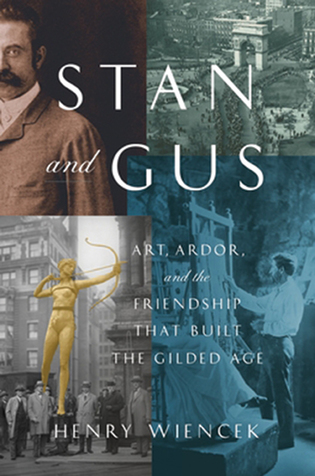
Stan and Gus: Art, Ardor, and the Friendship that Built the Gilded Age
Henry Wiencek ’74
Farrar, Straus and
Giroux, $30
Reviewed by Alexi Worth ’86
“Can you let me have $100 till the 15th? If so send it to me in cash.” That scribbled request was typical of the great American sculptor Augustus Saint-Gaudens’s relationship with his close friend, the architect Stanford White. From their first meeting, when the two men were in their twenties, they seem to have adored and depended on each other. Utterly different but equally brilliant, White and Saint-Gaudens were at the center of American cultural life in the decades after the Civil War. The more charismatic of the two, White did more than just lend his friend money: He arranged commissions, provided endless encouragement, and designed the settings for his sculptures—a key part of their overall impact.
In effect, the two men were collaborators. And perhaps more: Author Henry Wiencek suggests that theirs was a friendship with benefits. He cites letters addressed “Darling,” “Beloved,” “Sweetest,” and one from Gus that closes with a drawing of “a long row of erect phalluses.” The suggestion is surprising given that the two men were also flamboyantly heterosexual. Saint-Gaudens had not one but two families, and White—while also married—was a seducer of very young women, to the point that he was murdered by a jealous husband (on the rooftop of a building he had designed, the old Madison Square Garden).
Wiencek is a judicious guide to all of this, clear-eyed about the moral failings of his protagonists while appreciative of their achievements. He provides context, deftly selects letters and notes that let his subjects speak directly, and leaves the reader eager to visit the many sites where their works survive. I stopped by the grand, gilded Sherman monument on Fifth Avenue at 59th Street with Wiencek’s book in hand, and laughed to read his account of an early reviewer’s complaints. “Though splendid in its golden elegance,” the monument struck him as too “equivocal,” connoting war and peace simultaneously, and so leaving him with what he delicately called “a lapse of satisfaction.” And who was this impatient critic, irked by an artwork that felt too ambiguous? Henry James.
Alexi Worth ’86 is an artist based in New York City.
__________________________________________________________________
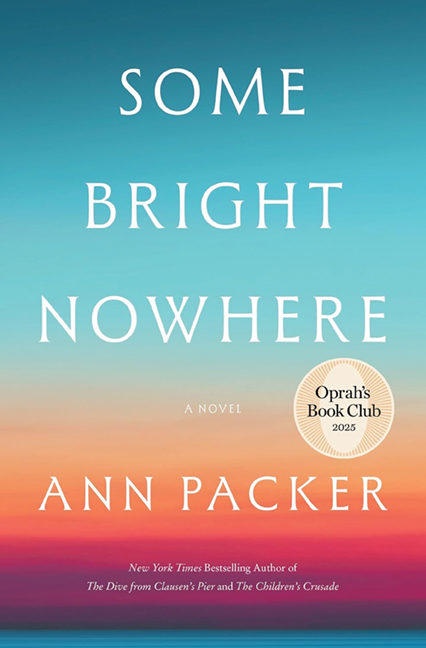
Some Bright Nowhere
Ann Packer ’81
Harper, $28.99
Reviewed by Bruce Holsinger
Anyone who has witnessed or participated in the arduous routines of eldercare will recognize the dilemma at the heart of Ann Packer’s fourth and most poignant novel. In the opening scene, Claire and Eliot, married for nearly forty years, leave their final appointment with the oncologist who has been treating Claire over the last eight years for cancer, soon to prove terminal. Once home, Eliot does everything he can—as he has been doing with loving (and somewhat self-satisfied) attention for a long time—to keep his dying wife comfortable, well fed, and entertained after a fashion. He organizes her meds, helps her get around, and takes small joy in cooking for the both of them.
But when Claire’s old friends Holly and Michelle come to visit, Claire makes a final request to her husband: that these cherished women, with their ribald humor, their fancy lotions, their manicures, remain in the house with her during her remaining months. Not as guests of the couple, but, Claire tells her husband, “instead of you.” The energy of this old female friendship is like a dagger she continually slips between his ribs, and Eliot takes it like the long-suffering husband he has long been. He moves out and Claire’s friends move in, and so begins one of the strangest spousal exiles ever imagined in fiction.
Packer takes brilliant delight in hinting at the minor secrets and hidden resentments that have structured this nevertheless loving marriage, though we see them only from Eliot’s point of view, and this is part of the narrative magic of the novel. In a late scene, Claire tries to explain what led her to displace her husband in favor of Holly and Michelle. It was, she says, a particular vision of her own death: “I wanted it to be pretty. Or something. Girly.” Eliot doesn’t get this yearning, but he does accept it. No spoilers here: Claire’s last days, and the novel’s closing pages, go by in a quiet dance of group caretaking among friends, children, and husband. “Everyone took turns administering morphine because they wanted to share the work.” A final, salving sentence for a book that asks us, and moves us, to live at the end of another’s life for just a while.
Author Bruce Holsinger’s most recent novel is Culpability.
__________________________________________________________________
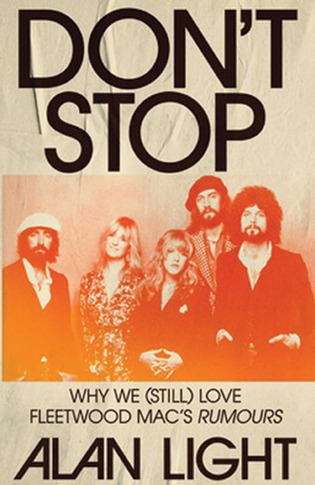
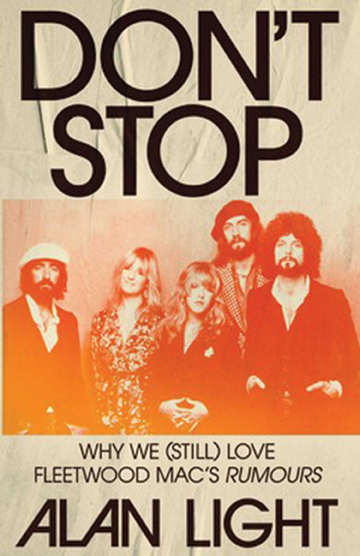
Don’t Stop: Why We (Still) Love Fleetwood Mac’s Rumours
Alan Light ’88
Atria Books, $29
Reviewed by Eric Olson ’11
Music culture is often credited with driving generations apart rather than pulling them together, but in this era of internet-driven dissonance, says longtime journalist Alan Light, Fleetwood Mac’s Rumours is the exception to every rule.
“Nothing else from rock’s Greatest Generation,” he writes, “has remained so present, so modern, and has continued to capture the contemporary imagination on such a large scale.”
From the band’s chaotic London inception to its equally chaotic Californian heyday, from album opener “Second Hand News” to the reissue’s closing track “Silver Springs,” Light dives as deep as the oxygen tank allows in exploring Fleetwood Mac’s most indelible album; it somehow finished atop the 2024 Billboard rock charts despite being released almost a half-century ago. He enlists descriptive help from luminaries such as drummer Ahmir “Questlove” Thompson, super-producer Mark Ronson, and journalist and film director Cameron Crowe, not to mention 30 or so postmillennial fans of the band.
Light is especially concerned with this lattermost cohort, who provide a bevy of qualitative data related to the book’s overarching question: “To put it simply, why do kids like this old-ass album?”
The book’s core is a track-by-track breakdown, during which Light explains the pop cultural stepping stones that returned Rumours to fashion. These include the viral TikTok moment in which a juice-drinking skateboarder lip-synced “Dreams,” the Fleetwood Mac episode of Glee from 2011, and the Clinton campaign’s selection of “Don’t Stop” as its theme song. Of course, as Light convincingly argues, none of it comes back around without that original studio magic.
Eric Olson ’11 is a Seattle-based writer whose work has appeared in The New York Times, Slate, and Literary Hub.
 loading


 Print
Print Email
Email