Beinecke Rare Book and Manuscript Library.
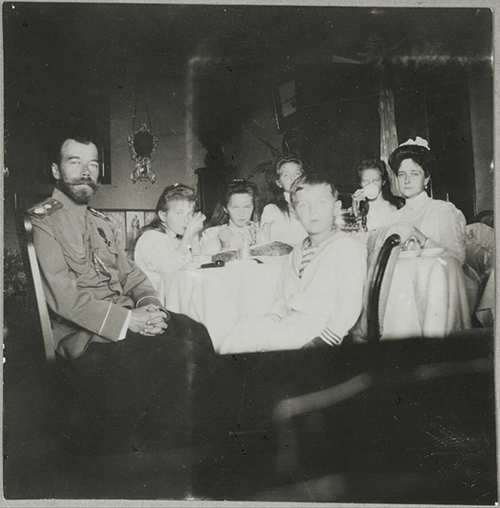
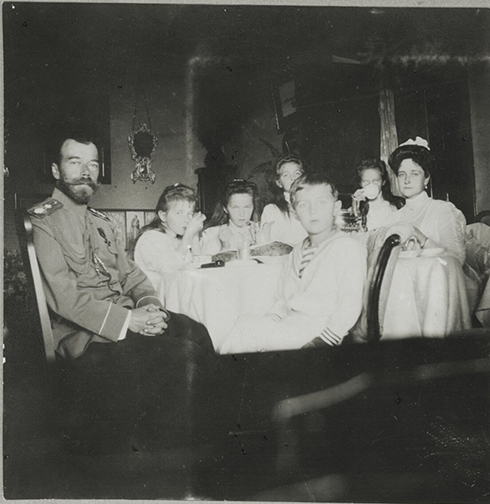
The image of the Romanovs in the dining room likely dates to 1909 and is one of hundreds included in the Romanov albums donated to the Beinecke Library in 1951.
View full image

Beinecke Rare Book and Manuscript Library.
The image of the Romanovs in the dining room likely dates to 1909 and is one of hundreds included in the Romanov albums donated to the Beinecke Library in 1951.
View full image
Beinecke Rare Book and Manuscript Library.
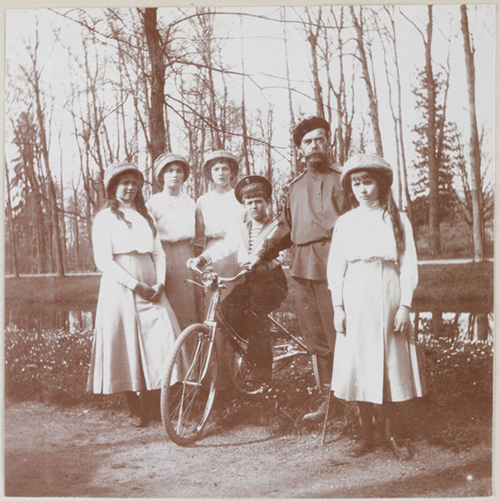
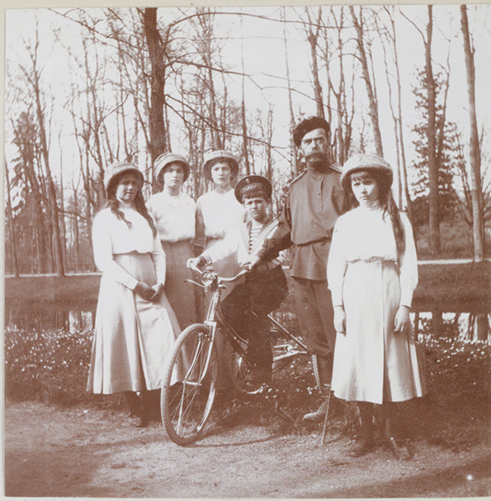
The photo taken in the countryside shows the family at leisure, though both male figures are wearing clothing that signify their official identities.
View full image

Beinecke Rare Book and Manuscript Library.
The photo taken in the countryside shows the family at leisure, though both male figures are wearing clothing that signify their official identities.
View full image
The first photo here depicts the Russian tsar Nicholas II—last of the Romanov emperors, who ruled from 1894 until March 1917—at table with the Empress Alexandra, their four daughters, Princesses Olga, Tatiana, Maria, and Anastasia, and their son and heir to the throne, Aleksei. They are shown in the dining room of their summer palace in Livadia, on the Crimea, enjoying a light meal after Holy Communion. It is one of hundreds of photographs depicting the imperial family at leisure, many taken by themselves, which they assembled in family photo albums.
The image in the dining room was likely taken by Anna Vyrubova (1884–1964), a close confidante of the empress and herself a camera enthusiast. The date is probably 1909, when Aleksei would have been five years old. The album itself, along with five others, was salvaged by Vyrubova when she fled the country after 1917. She eventually sold them to Yale alumnus Robert D. Brewster ’39, who later donated them to the Beinecke Library. Another Yale alumnus, Robert K. Massie ’50, used the images in constructing Nicholas and Alexandra, his best-selling portrait of the imperial family in its final years, a story that has captured the imagination of millions of readers.
The images draw their pathos from our knowledge of their protagonists’ impending fate: their brutal murder in 1918 by the newly installed Bolshevik rulers, engaged in a fierce struggle for power after revolution had toppled the autocratic old regime. Technically private citizens once Nicholas had abdicated the throne, the family remained symbols of power. At the time of this photograph, the dynasty already felt itself in danger. Before being energetically repressed, the Revolution of 1905 had challenged the tsar’s absolute power and diminished his aura. Until the outbreak of war in 1914, the rituals, ceremonies, and prerogatives of the ruling house nevertheless persisted. The albums show the imperial family not in their public functions, however, but in their domestic lives—off-duty, so to speak. The images show, paradoxically, that private life was never really private but always staged, always under scrutiny. It is rare that Nicholas is not wearing one kind of uniform or another.
The overall impression is one of cosseted luxury. Photos depict the royal figures in their numerous palaces, at the Finnish coast, in Crimea, on the imperial yacht. They are shown engaged in various activities—on the tennis court, on the beach, the women doing needlework, Nicholas at the hunt or shoveling snow, children sledding in winter, the tsarevich at play. Indeed, official court propaganda emphasized the image of Nicholas as “an ordinary man,” thus seeking to repair the breach widened in 1905 between the ruler and the mass of his impoverished subjects, whose faith in his divinely inspired authority seemed to be slipping away.
Such ordinary people, with the exception of sailors on the imperial yacht, rarely appear in the photos. You do not see the hosts of servants who always surrounded the royals and who made their lives of luxury possible, on the public stage and in the boudoir.
In 1909, the tsar’s subjects were still waiting in the wings. They made their appearance less than a decade later, bringing the Romanov story to its bloody end and with it, Nicholas and his family.
Today’s Russian rulers hail the last tsar as a patriotic hero. Historians debate the extent to which Nicholas and Alexandra contributed, by weakness of character and poor statesmanship, to the collapse of the empire. Should they be considered martyrs to ideological fanaticism or coauthors of the revolution that cost them their lives? Images of Nicholas as a “private man” do not resolve these essentially political questions.
 loading

 Print
Print Email
Email